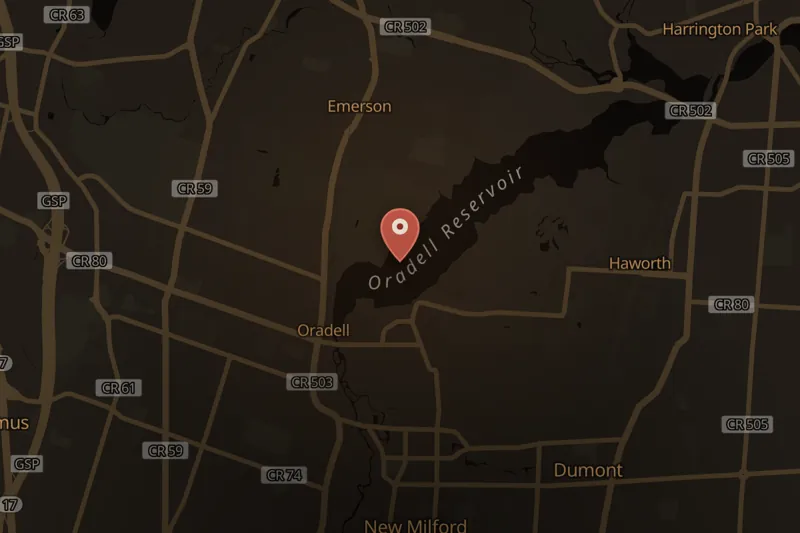
In 1966, authorities in Bergen County, New Jersey, including prosecutor Guy W. Calissi, investigated nine suspicious deaths at Riverdell Hospital in Oradell. The patients had been admitted for surgery and died of causes unrelated to their procedures. The investigation began on November 1, 1966, after eighteen vials of curare, most nearly empty, were found in a locker assigned to surgeon Mario Enrique Jascalevich. When confronted, Jascalevich said he had been experimenting with dogs. Investigators could not establish a homicide motive at the time, and the case went dormant for a decade.
In the mid-1970s, The New York Times received an anonymous letter alleging that as many as 40 patients had been murdered at a hospital by its chief surgeon. Reporter M. A. Farber pursued the claim, eventually identifying Riverdell Hospital and Jascalevich, whose surgical patients routinely survived while those of another surgeon at the hospital were dying at an unusually high rate. Farber reviewed the 1966 case files, in which Calissi had written "someone is lying," though Calissi and his assistant Fred C. Galda had concluded at the time that hard evidence was lacking. Farber contacted families of possible victims, some of whom learned for the first time that the deaths had been considered suspicious, and made repeated unsuccessful attempts to contact Jascalevich. The Times published Farber's findings in January 1976, referring to the unidentified physician as "Dr. X," prompting extensive coverage by other newspapers. A subsequent independent investigation by Bergen County Prosecutor Woodcock exhumed five bodies; traces of curare were found in three, none of whom had been administered the drug during surgery.
On May 18, 1976, a Bergen County grand jury indicted Jascalevich on five counts of murder involving patients Emma Arzt, Frank Biggs, Margaret Henderson, Carl Rohrbeck, and Nancy Savino, alleging he had injected them with curare. Two counts were later dismissed for lack of evidence. At trial in 1978, prosecutor Sybil Moses faced defense attorney Raymond A. Brown, who subpoenaed Farber's reporting notes on 193 potential witnesses—described by Farber as "the broadest subpoena ever issued to an American reporter." After 34 weeks of testimony, a jury acquitted Jascalevich on October 24, 1978.
In October 1980, the New Jersey Board of Medical Examiners revoked Jascalevich's medical license, citing gross malpractice, gross negligence, and failure of good moral character in matters unrelated to the murder charges, including fraudulent operation records and a false cancer diagnosis. In January 1982, New Jersey Governor Brendan Byrne pardoned Farber and ordered return of contempt fines levied against him and The Times. Riverdell Hospital, renamed Northern Community Hospital in 1979, closed in 1981 and was demolished in June 1984. Jascalevich returned to Argentina after losing his license and died in September 1984 in Mar del Plata of a cerebral hemorrhage; his death was not publicly reported for several months. The Riverdell deaths remain officially unsolved.


 Credit: Jim Harper (Pixel23 at English Wikipedia)CC BY-SA 2.5SourceSOLVEDListen