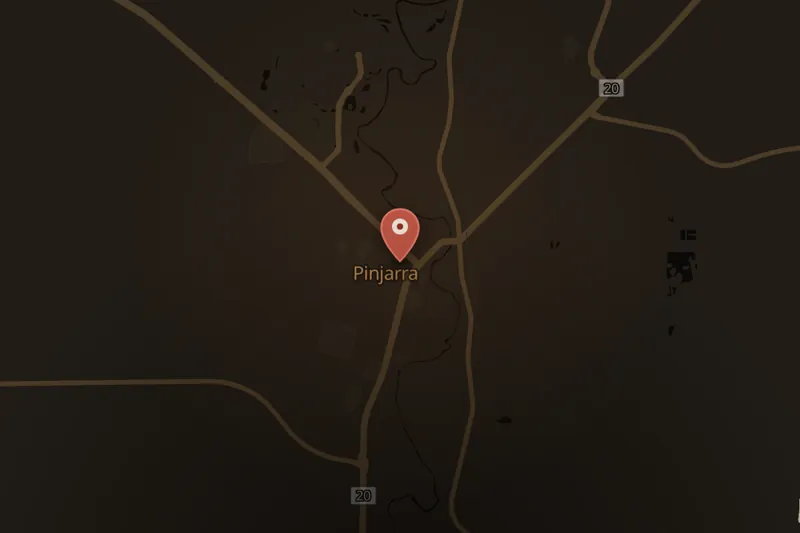
On 28 October 1834, a detachment of 25 soldiers, police and settlers led by Western Australian Governor James Stirling attacked a group of Bindjareb Noongar people camped at Pinjarra on the Murray River. Contemporary estimates put the number of Bindjareb people present at the camp at between 60 and 80, based on figures given by Stirling, expedition member John Roe, and an unidentified eyewitness. The event, historically referred to as the "Battle of Pinjarra," is now widely described as a massacre.
The attack followed years of escalating conflict between newly arrived colonial settlers appropriating land in the Swan River Colony and the Noongar peoples who lived there. Precipitating incidents included the 1832 spearing death of Private George Budge, the wounding of Sergeant Wood, and the July 1834 killing of Hugh Nesbitt, a servant of settler Thomas Peel, along with the wounding of Edward Barron and an armed raid on a flour mill. Acting Lieutenant Governor Frederick Irwin is described as having taken a hardline stance during Stirling's absence, and Stirling organised the mounted party to confront Bindjareb people led by Calyute after settlers in Pinjarra sought protection.
The party left Perth on 25 October 1834 and, after gathering supplies, personnel and ammunition, tracked a group of Bindjareb men, women and children toward Pinjarra, camping nearby on the evening of 27 October to launch a surprise attack before dawn. On the morning of 28 October, the group was located at a camp of about 20 shelters. An initial clash saw Superintendent Theophilus Tighe Ellis speared; he died of his injuries on 11 November after weeks in a coma. Corporal Patrick Heffron was wounded in the arm but recovered. Bindjareb people were driven into the river and surrounded, with reports indicating men, women and children were shot as they attempted to hide or float downstream; sustained fire and pursuit continued for roughly ninety minutes.
Casualty estimates for the Bindjareb vary widely. Stirling reported approximately 15 men killed; Roe estimated 15–20. An unidentified settler eyewitness counted 25–30 dead, including a woman and several children, and suggested more bodies may have floated downstream unseen. Captain Daniel, sent afterward to survey the site, reported finding mass graves but was unable to exhume bodies for an official count due to rain and safety concerns. Advocate-General George Fletcher Moore separately estimated 25–30 dead. Eight women and some children were taken captive. Named Bindjareb dead reportedly included Unia, a son of Calyute, and Gummol; two of Calyute's wives, Yornup and Mindip, were among the wounded.
Following the attack, Stirling reportedly threatened further mass killing in the event of retaliation. The massacre is described as having severely weakened the Bindjareb relative to neighbouring Aboriginal groups and enabling Stirling to acquire Bindjareb land in the Harvey district. A peace deputation and corroboree took place roughly five months later. Since 1991, the event has been commemorated annually by the Binjareb people as Back to Pinjarra Day, and on 28 October 2025 the Governor of Western Australia formally apologised for the massacre.


 SOLVEDListen