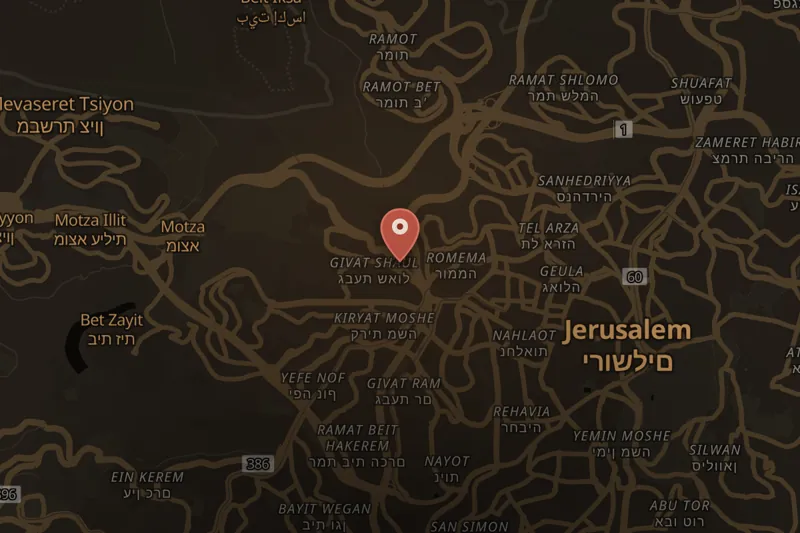
On the morning of 30 November 2023, two gunmen opened fire on civilians waiting at a bus stop on the Givat Shaul Interchange in Jerusalem, a major entrance point to the city. The attack occurred hours after Hamas and Israel had agreed to extend a ceasefire in the Gaza war. Three civilians were killed and 16 others wounded. The attackers, identified by Israeli Police as brothers Murad Nemer, 38, and Ibrahim Nemer, 30, from the Sur Baher neighborhood of East Jerusalem, had reportedly both previously been imprisoned over affiliation with Hamas. They arrived by car around 7:30 a.m. armed with an M16 rifle and a handgun, and the vehicle also contained a large quantity of ammunition. Hamas claimed responsibility for the attack.
The three civilians killed by the gunmen were named as 73-year-old rabbi Elimelech Wasserman, 67-year-old Chana Ifergan, and 24-year-old Livia Dickman, who was pregnant; the fetus could not be saved. Six other wounded were taken to Hadassah Ein Kerem Hospital, three in serious condition.
During the attack, a bystander, 37-year-old lawyer Yuval Doron Kestelman, a former Israeli security forces member from Mevaseret Zion, opened fire on the attackers and was credited with killing one of them. Reservist soldier Roi Eisenbach also engaged and killed one attacker. In the course of the response, Kestelman was shot by one of two responding soldiers, Eisenbach or Aviad Freija, after being mistaken for an attacker. According to witness accounts, Kestelman discarded his weapon, knelt, removed his jacket, and raised his hands, reportedly shouting that he was Israeli, but was shot further times. He received no aid from initial responders who believed him to be an attacker, was later taken to Shaare Zedek Medical Center, and died that evening.
An investigation, initially conducted by Jerusalem District Police before the Military Police Investigation Unit joined following public pressure, examined the circumstances of Kestelman's death. Freija was interrogated and arrested. A CT scan later found metallic bullet fragments in Kestelman's body, prompting exhumation and a full autopsy on 10 December, which found an M16 bullet and fragments, contradicting an earlier claim used in court proceedings that had led to Freija's release to house arrest. Forensic examination of Kestelman's jacket found no gunshot damage, supporting the conclusion that the fatal shots were fired after he had removed the jacket and knelt. A military court hearing on 5 December found that Freija had "fired unlawfully," and he was placed under house arrest.
The case generated public debate in Israel over rules of engagement, extrajudicial killings of attackers, medical treatment of the wounded, and policies expanding civilian weapon distribution following the October 7 attacks. IDF Chief of Staff Herzi Halevi praised Kestelman's actions while cautioning against premature use of force. Prime Minister Benjamin Netanyahu's remarks about the "costs" of the policy drew criticism, and he later called Kestelman's father to call his death a "terrible tragedy" and promise an investigation.

 ONGOINGListen


