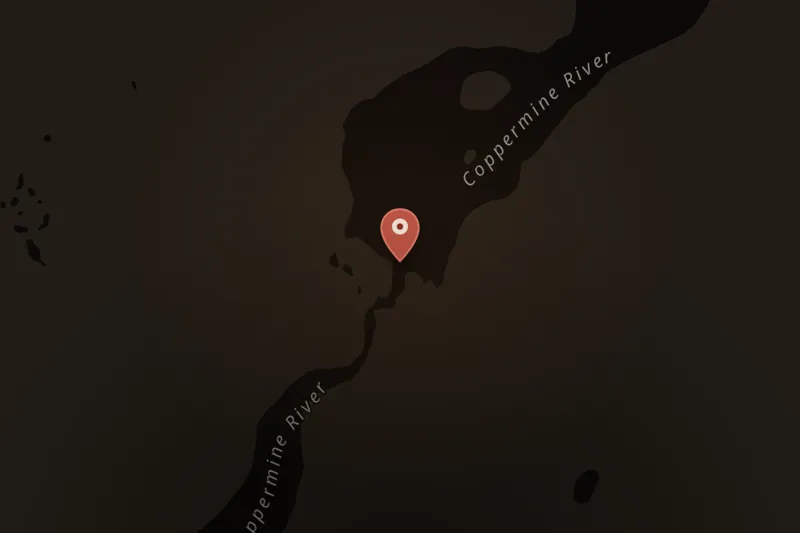
The Bloody Falls massacre refers to a violent attack that reportedly occurred on 17 July 1771 near modern-day Kugluktuk, Nunavut, during Hudson's Bay Company employee Samuel Hearne's expedition to survey the Coppermine River for copper deposits. The account of the massacre comes from a travel narrative attributed to Hearne, published after his death and containing substantial editorializing; Hearne's original travelogue is now lost.
According to the narrative, in late May 1771 Hearne began to suspect that the Chipewyan men accompanying him, led by his guide and companion Matonabbee, had motives beyond the planned survey. At Clowey Lake, the men fashioned shields, and additional Indigenous men joined the party seemingly intent on making war against the Inuit. Hearne wrote that he attempted to dissuade his companions from violence but was accused of cowardice for doing so. On 1 June 1771, women, children, dogs, and heavy luggage were left behind, and a party of about 60 men advanced toward the Coppermine River. On 2 July 1771, the group encountered Copper Indians who provided canoes and supplies; 17 men subsequently left the party, reportedly finding the trek not worth the anticipated violence.
The remaining party reached the Coppermine River on 14 July 1771. Scouts sent out on 14 July returned on 16 July, reporting five Inuit tents on the river's west side. Survey work stopped as the men prepared for an attack. Just after midnight on 17 July, the Dene men attacked the Inuit camp, killing approximately 20 men, women, and children. Hearne described being deeply affected by what he witnessed, stating he could not reflect on the events "without shedding tears." He claimed to have named the waterfall Bloody Falls as a result.
The narrative's veracity has been disputed. Dene oral history holds that Hearne himself was not present at the event, and some of Hearne's contemporaries questioned his account. The oral history of Inuit-Dene relations in the region also does not reflect the Bloody Falls story as told in the published narrative.
Decades later, explorer Sir John Franklin, during his Coppermine Expedition of 1819–1822, reported finding human skulls bearing marks of violence and scattered bones at a site matching Hearne's description, which he took as corroboration of the earlier account.
The site, traditionally home to the Kogluktogmiut, is now within Kugluk/Bloody Falls Territorial Park near Kugluktuk, Nunavut. It was designated a National Historic Site in 1978, primarily in recognition of its long history as a fishing site and caribou hunting station used by Pre-Dorset, Thule, First Nation, and Inuit peoples over roughly three millennia, rather than specifically for the alleged massacre. In 1996, Dene and Inuit representatives took part in a joint healing ceremony at the site.

 UNSOLVEDListen