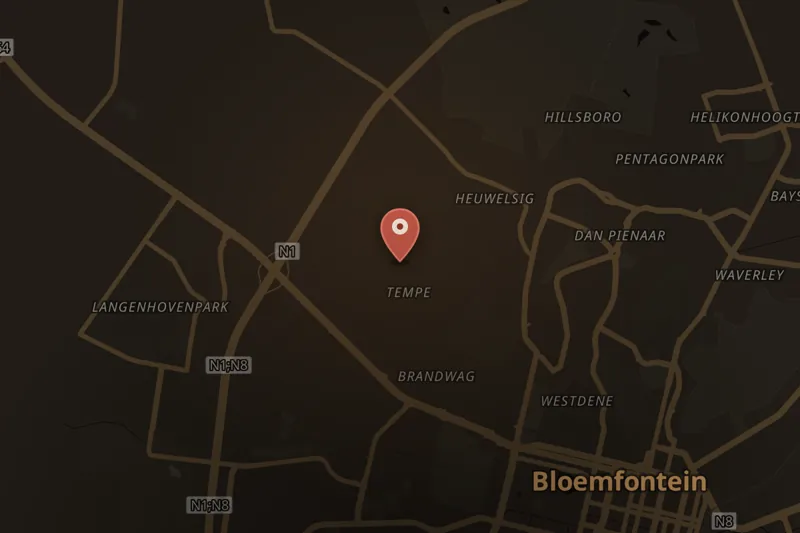
On 16 September 1999, a mass shooting occurred at the Tempe military base near Bloemfontein, South Africa. Lt. Sibusiso Madubela, a 28-year-old former Azanian People's Liberation Army (APLA) guerrilla fighter who had joined the South African Army in 1994, shot and killed eight people — seven soldiers and one civilian — before being shot dead by two soldiers, Sergeant Major Aldo Mattheus and another soldier, Anton Otto. Four others were injured, one of whom, Major Zirk Coetsee, later died of his wounds. Every person killed or injured was white, and witnesses reported that Madubela at times pushed black soldiers out of the way in order to shoot white ones, sparing more than 20 black soldiers he encountered during the 15-minute attack.
The shooting followed Madubela's absence without leave after attending his father's funeral, which resulted in the suspension of his pay. On the day of the shooting, he had sought to speak to the base commander about the pay cut, was told the officer was unavailable, and shortly afterward signed for an R4 rifle and ammunition before opening fire on personnel of the 1 SA Infantry Battalion. Victims included Captain Hannes de Jager, Marita Hamilton, Warrant Officer Reg Sieberhagen, Major Jacques Coetzer, Sergeant Tertius Lombard, Warrant Officer Johan Lombard, Sergeant Doughie Douglas, and Sergeant Willie Nell.
Tempe was one of South Africa's largest military bases and one of the first to integrate after apartheid, and had a history of racially charged incidents, including a 1996 assault on former liberation fighters and a 1998 theft and killing linked to a right-wing group. A subsequent Ministerial Committee of Inquiry examined discrimination and sectarian tension within the South African National Defence Force (SANDF), finding evidence of racial imbalance in command structure — nearly 60 percent of personnel were black, but 70 percent of officers were white. The inquiry concluded that Madubela alone was responsible for the deaths, that he had deliberately targeted white victims, and that the shooting stemmed from the suspension of his salary. Commentators, including writer Pan Pantziarka, suggested the recent death of Madubela's father and long-standing grievances may have combined with the pay dispute as contributing factors.
Reactions to the shooting were sharply divided along political and racial lines. Some Pan Africanist Congress (PAC) officials and supporters described Madubela as a martyr, while right-wing groups characterized the attack as evidence of anti-white racial violence. Defence Minister Mosiuoa Lekota stated he saw no evidence of racism as a motive. Following a legal application by the PAC, the military paid for Madubela's funeral, held on 2 October 1999, though it declined to provide a guard of honor. The funeral, attended by roughly 2,000 people, was marked by inflammatory speeches from PAC officials and ended when an unauthorized 12-gun salute prompted police to fire ammunition and tear gas, wounding three people. Victims' families later sued the military for R5 million in damages. In 2003, survivors Aldo Mattheus and the family of the deceased Zirk Coetsee were formally recognized for their actions in stopping the shooting.

 Credit: SobakaPublic domainSourceSOLVEDListen