
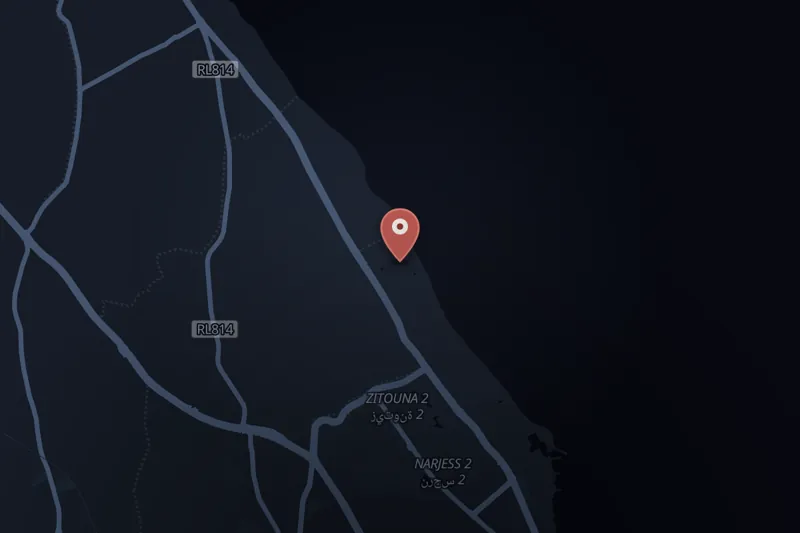

Tunis, Tunisia · 1980s
Assassination of Khalil al-Wazir
Palestinian Fatah co-founder and PLO military commander Khalil al-Wazir (Abu Jihad) was killed by Israeli commandos in a Mossad-led raid on his home in Tunis on 16 April 1988.
Solved case · 2015
Also known as Sousse attacks · Atentado de Susa
The short answer
On 26 June 2015, a gunman attacked tourists at a beach resort in Port El Kantaoui near Sousse, Tunisia, killing 38 people, 30 of them British, in the deadliest non-state attack in modern Tunisian history.
No one's coverage is attached to this file yet.
Know great coverage of this case?
A documentary, a podcast episode, a careful long-form video. Suggest it and an editor will review it before it appears here.
Suggest coverage for 2015 Sousse attacksOn 26 June 2015, a mass shooting occurred at the Riu Imperial Marhaba Hotel, a Spanish-owned five-star resort in Port El Kantaoui, roughly ten kilometres north of Sousse, Tunisia. The hotel was hosting 565 guests, mostly from Western Europe, and tourists from the hotel and the nearby Soviva Hotel were on the beach when the attack began around noon.
The attacker, Seifeddine Rezgui Yacoubi, a 22-year-old electrical engineering student from Gaâfour in northwest Tunisia, disguised himself as a tourist and socialised with others before producing a Kalashnikov assault rifle he had concealed in a beach umbrella. He opened fire on tourists on the beach, then entered the hotel, continuing to shoot people and reportedly throwing grenades. He was killed by security forces during an exchange of fire. An autopsy found medications and an illegal drug in his system. All fired bullets were traced to his single weapon, for which he carried four magazines of ammunition. During the attack he spoke with his father by mobile phone before throwing the phone into the sea; it was later retrieved. A Tunisian Interior Ministry spokesman said officials believed others had assisted, supplying the rifle and helping Rezgui reach the scene, without participating directly.
Thirty-eight people were killed, 30 of them British, and thirty-nine others were wounded. Victims included Denis Thwaites, a former professional footballer for Birmingham City, and his wife Elaine, as well as three generations of one family: Adrian Evans, Patrick Evans and Joel Richards. The attack surpassed the March 2015 Bardo National Museum attack, which had killed 22 people, as the deadliest non-state attack in modern Tunisian history.
In January 2017, documents obtained by the BBC's Panorama identified Chamseddine al-Sandi as the orchestrator behind the attack, based on confessions from arrested suspects, who said al-Sandi ran a militant cell responsible for both the Sousse and Bardo attacks; both were claimed by the Islamic State.
An inquest in London found the Tunisian police response "at best shambolic and at worst cowardly," noting that armed security personnel near the attack retreated for roughly half an hour awaiting reinforcements while the gunman continued killing. By March 2017, Tunisian authorities had referred at least six police officers to trial for criminal negligence and 27 others on similar charges. The coroner ruled the victims were "unlawfully killed," and relatives subsequently pursued legal action against tour operator TUI through law firm Irwin Mitchell, representing 85 affected families; a settlement was later reached without admission of liability. The Tunisian government "acknowledged fault" for the slow police response. A memorial to the British victims, "Infinite Wave," was unveiled in Birmingham in March 2019.
Seifeddine Rezgui Yacoubi attacks tourists at Port El Kantaoui near Sousse, killing 38 people and wounding 39; he is killed by security forces.
Queen Elizabeth II expresses shock at the attack and offers sympathy to the injured.
UK Home Secretary Theresa May and Foreign Office Minister Tobias Ellwood visit the attack site; an RAF C-17 flight begins repatriating British victims.
Repatriation of bodies of the 30 British nationals killed begins, continuing through 4 July.
UK holds a nationwide minute of silence at 12:00 local time to mark one week since the attack.
Tunisian President Beji Caid Essebsi removes the provincial Governor of Sousse and at least five senior police officers.
UK Foreign and Commonwealth Office changes travel advice for Tunisia to advise against all but essential travel.
Tunisian MPs begin a three-day debate on new counter-terrorism legislation.
UK inquest into the attack initially scheduled to start, later postponed to 2017.
First hearing of the UK inquest held at the Royal Courts of Justice in London.
BBC Panorama documents identify Chamseddine al-Sandi as the orchestrator of the attack based on suspects' confessions.
At least six Tunisian police officers referred to trial for criminal negligence and 27 others on similar charges, according to the Tunisian Justice Ministry.
Britons Allen Pembroke and Paul Short awarded the Queen's Commendation for Bravery for aiding victims during the attack.
Memorial "Infinite Wave" to British victims and a Bardo attack victim unveiled in Cannon Hill Park, Birmingham, by Prince Harry, Duke of Sussex.
Victims first. Every legal label is set from public records and court outcomes, not from the prose.
British victim killed in the attack, part of a three-generation family group.[3]
British victim killed in the attack; former professional footballer for Birmingham City.[3]
British victim killed in the attack; wife of Denis Thwaites.[3]
British victim killed in the attack, part of a three-generation family group.[3]
British victim killed in the attack, part of a three-generation family group.[3]
Coverage is not a source: every fact in this file rests on the records below.
Are you family of someone named in this file? Corrections and removal requests from victims’ families are prioritized.
Tunis, Tunisia · 1980s
Palestinian Fatah co-founder and PLO military commander Khalil al-Wazir (Abu Jihad) was killed by Israeli commandos in a Mossad-led raid on his home in Tunis on 16 April 1988.
 Credit: YamenCC BY-SA 4.0SourceSOLVEDListen
Bardo National Museum, Tunis, Tunisia · 2010s
On 18 March 2015, two gunmen attacked the Bardo National Museum in Tunis, killing 21 people at the scene—mostly European tourists—and injuring around 50 others; a further victim died ten days later. Tunisian security forces killed both attackers, later identified as Yassine Labidi and Saber Khachnaoui.
 Credit: Pax Ahimsa GethenCC BY-SA 4.0SourceSOLVEDListen
Pulse nightclub, Orlando, Florida, United States · 2016
On June 12, 2016, Omar Mateen, identified by police as the gunman, shot and killed 49 people and wounded 58 others at Pulse, a gay nightclub in Orlando, Florida, during a Latin Night event, before being fatally shot by police after a three-hour standoff.
 Credit: Canadaolympic989CC BY-SA 3.0SourceSOLVEDListen
Sandy Hook Elementary School, Newtown, Connecticut · 2012
On December 14, 2012, 20-year-old Adam Lanza fatally shot his mother at their Newtown, Connecticut home, then killed 20 children and six adult staff members at Sandy Hook Elementary School before killing himself as police arrived.
 Credit: AlgrCC BY-SA 3.0SourceSOLVEDListen
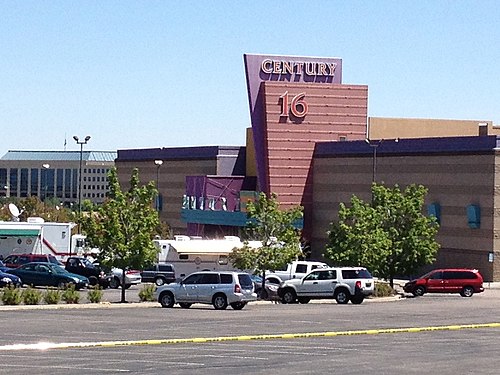
Century 16 theater (now Century Aurora), Aurora, Colorado · 2012
On July 20, 2012, James Eagan Holmes opened fire during a midnight screening of The Dark Knight Rises at a Century 16 theater in Aurora, Colorado, killing 12 people and injuring 70 others. He was convicted in 2015 of 24 counts of first-degree murder and sentenced to life in prison.
 Credit: Credits to Mourad Ben Abdallah / Wikimedia CommonsCC BY-SA 3.0SourceSOLVEDListen
El Ghriba Synagogue, Djerba, Tunisia · 2023
On May 9, 2023, a Tunisian National Guardsman killed five people—including a colleague, two Jewish pilgrims, and two police officers—in a premeditated attack near the El Ghriba Synagogue in Djerba, Tunisia, before being shot dead by security forces.