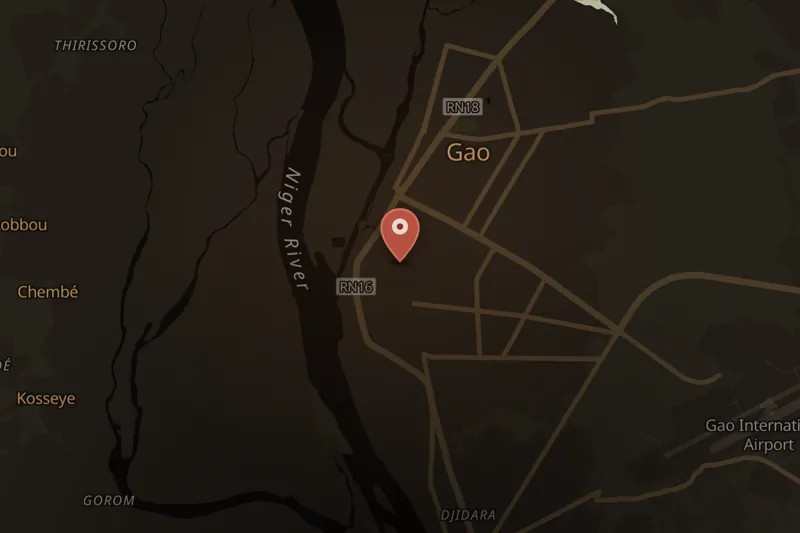
On the morning of 18 January 2017, at approximately 09:00 local time, a vehicle packed with explosives was driven into the Joint Operational Mechanism base near Gao, Mali. The base housed members of the Malian Army alongside former militants who had signed a peace agreement with the government. According to a Malian army spokesman, the vehicle bore insignia matching the active military unit operating in the area, which may have allowed it to approach without immediate suspicion.
In the immediate aftermath, casualty figures varied. Mali's state broadcaster ORTM initially reported 47 dead, while the office of the President of Mali estimated 60 fatalities and 115 injured. The following day, 19 January, a French Army spokesman said the confirmed death toll had risen to 77. This is described as the deadliest terrorist attack in the country's history.
Al-Qaeda in the Islamic Maghreb claimed responsibility for the bombing through its affiliate, Al-Mourabitoun, describing the attack as "punishment for Mali's cooperation with France." The group's statement attributed the attack specifically to the Mourabitoun battalion and named the bomber as Abdul Hadi al-Fulani. No individual has been charged in a court of law in connection with the attack based on available reporting.
In response, Malian President Ibrahim Boubacar Keita declared a three-day period of national mourning. Foreign Minister Abdoulaye Diop condemned the attack as "criminal, cowardly, [and] barbaric," while stating that it would not derail the government's ongoing efforts to negotiate peace with the country's militant fighters. Defence Minister Abdoulaye Idrissa Maïga was scheduled to travel to Gao in the wake of the bombing to assess the response.
The attack targeted a facility central to Mali's peace process, as it combined government soldiers with former armed group members who had committed to a peace agreement, underscoring the vulnerability of reconciliation efforts in the country's ongoing conflict involving militant Islamist groups operating in the region.

 UNSOLVEDListen


