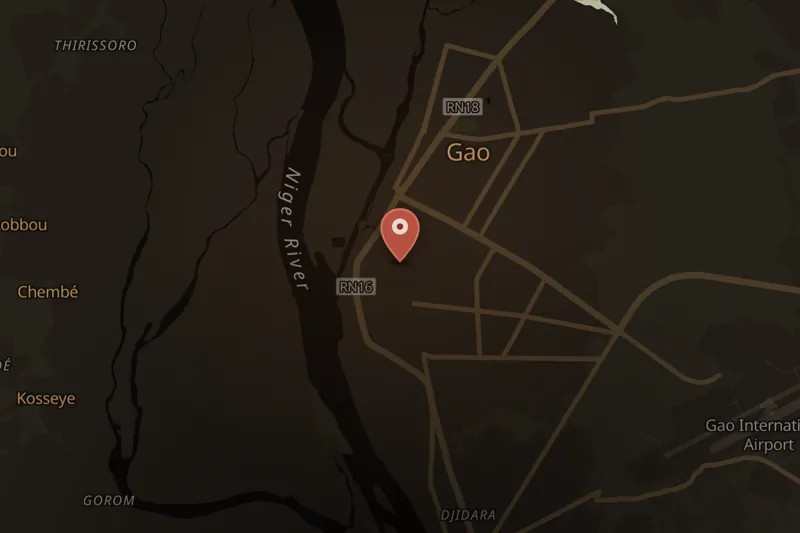
Between February 8 and 10, 2022, militants from the Islamic State in the Greater Sahara (ISGS) killed at least 40 civilians in the villages of Keygourouten, Khadji, Bakal, Tadjalalt, and Abagazgaz, located in the commune of Tessit, Ménaka Region, Mali.
Background: Eastern Mali's Ménaka region has for years been a site of competition between ISGS, the al-Qaeda-affiliated Jama'at Nusrat al-Islam wal-Muslimin (JNIM), and the pro-government Tuareg militia Movement for the Salvation of Azawad (MSA). In early 2022, ISGS was preparing an offensive intended to seize control of the entire Ménaka region, which began in March 2022.
The massacres: Before the killings, JNIM militants accused local residents of supplying ISGS fighters, ordered shopkeepers to close, ransacked shops and hospitals, and stole an ambulance. JNIM then ordered residents to leave their villages; an estimated 150 to 200 households complied, fleeing to Niger and to other parts of Mali, with many going to Tessit and Gao, both under government control.
ISGS militants subsequently entered the area after JNIM's departure and accused civilians in Keygourouten, Khadji, Bakal, Tadjalalt, and Abagazgaz of sympathizing with JNIM, a group ISGS considers heretical. According to the source, the fighters massacred all men, old and young, in these towns; thirty men were reported executed in Tadjalalt alone. A local MSA official and a local Malian official, both citing accounts from refugees, said approximately 40 civilians were killed across the towns.
In the aftermath, Malians and Nigeriens organized a social media campaign under the hashtag #JeSuisTessit to express solidarity with the victims. Around 1,200 people were displaced within Mali as a result of the ISGS massacres. The Malian government did not comment on the killings.
Aftermath: ISGS continued to attack civilians during its broader campaign in the Ménaka region. Between March 21 and 23, 2022, around 100 civilians were reportedly killed in villages near Talataye, and 229 civilians were killed in the area between Inchinanane and Intakore during the same period.


 Credit: ThesupermatCC BY-SA 4.0SourceSOLVEDListen