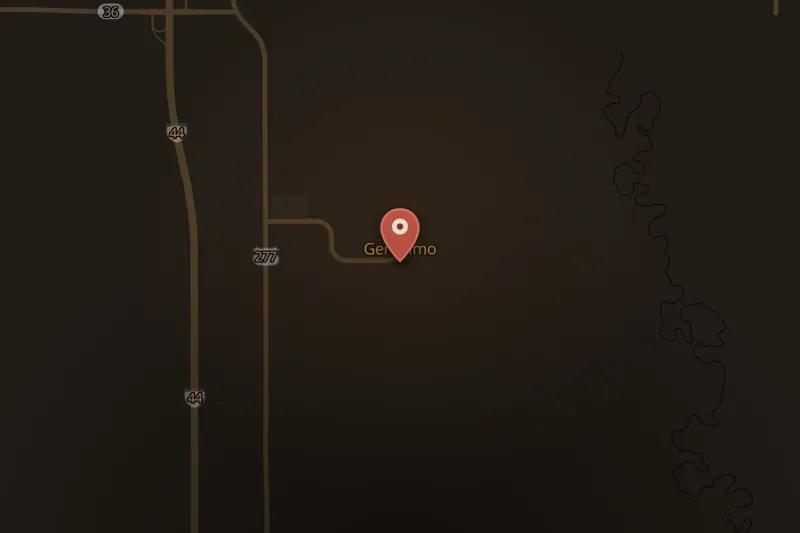
On December 14, 1984, Jay Wesley Neill robbed the First Bank of Chattanooga, a small branch bank in Geronimo, Oklahoma. Neill and Robert Grady Johnson shared an apartment in Lawton, Oklahoma, and a joint checking account at the Geronimo bank, which had frequently overdrawn due to insufficient funds. Neill had previously remarked to Johnson about how easy he thought it would be to rob the bank, which was housed in a small prefabricated building with only two tellers and no surveillance cameras or security guards.
In the days before the robbery, Neill attempted to purchase a firearm but was turned away for being under 21. Johnson then applied for a gun license, and the pair purchased a revolver together on the morning of the robbery. Neill also purchased plane tickets to Nassau, Bahamas for a flight leaving the evening of the robbery.
At around 1 p.m. on December 14, 1984, Neill entered the bank at gunpoint and forced three tellers — Kay Bruno, 42; Jerri Bowles, 19; and Joyce Mullenix, 25, who was six months pregnant — into a back room, where he stabbed them to death. The three women were stabbed a total of 75 times. While Neill was attempting to decapitate one of the victims, four customers entered the bank. He took them to the back room and shot them in the head. One of them, Ralph Zeller, 33, died from his wounds, becoming the fourth murder victim. Bellen and Reuben Robles, along with Marilyn Roach, survived their head wounds. Neill attempted to shoot the Robleses' 14-month-old daughter, Marie, but the gun was out of ammunition. According to an FBI report, Johnson was 16 miles from the crime scene during the robbery.
Neill and Johnson were arrested on December 17, 1984, in San Francisco, California, after using marked bills stolen from the bank to pay for hotel rooms, limousine rides, and shopping. Around $3,700 in marked bills was recovered from Neill and their hotel room.
Neill was convicted and sentenced to death twice — first in 1985, and again in 1992 after his initial sentence was overturned due to procedural errors. Johnson was convicted and sentenced to four life sentences, with courts noting a factual dispute over whether he was present in the bank during the robbery; Neill gave conflicting accounts on this point at different times. Johnson's sentences allowed for the possibility of parole, though he is also described as having received life without parole.
Neill's appeal was denied by the U.S. Supreme Court on October 7, 2002. He was executed by lethal injection on December 12, 2002, having offered an apology to the victims' families and asserting again that Johnson had not been present in the bank. He was the 54th person executed by the state of Oklahoma since it resumed executions in 1990.

 SOLVEDListen