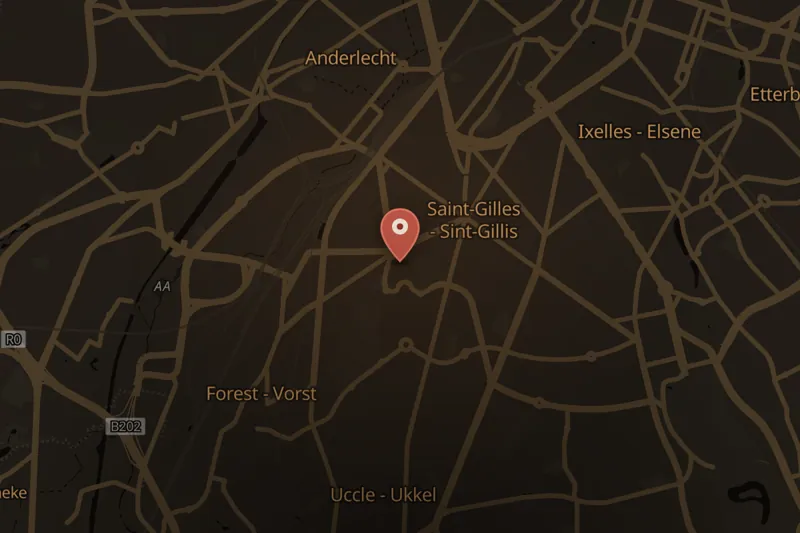
On the afternoon of 24 May 2014, a gunman opened fire inside the Jewish Museum of Belgium in the Sablon/Zavel district of central Brussels. He shot an Israeli couple, Emmanuel and Miriam Riva, in the museum's entrance, then a Belgian employee, Alexandre Strens, at the reception desk, before shooting a French volunteer, Dominique Sabrier, at her desk in a nearby room. The attack lasted less than ninety seconds and was recorded on the museum's security cameras. The Rivas and Sabrier died instantly; Strens was critically injured and died in hospital roughly two weeks later without regaining consciousness. Belgian authorities characterized the shooting as an antisemitic, Islamist terrorist attack — the first carried out in Europe by the Islamic State.
Following a nationwide manhunt and the release of partial CCTV imagery, Mehdi Nemmouche, a 29-year-old French national, was arrested on 30 May 2014 during a routine drugs check at a bus station in Marseille, France. He was found carrying weapons identical to those used in the attack, a sheet bearing ISIS insignia, and a video in which he claimed responsibility for the killings in the name of ISIS. Nemmouche had a prior criminal record in France, was radicalized while imprisoned, and had spent more than a year in Syria after his release, where French former hostages later testified he had served as one of their guards. A second suspect, Nacer Bendrer, who had met Nemmouche in prison, was identified and arrested for supplying the weapons used in the attack. Investigators also identified a third suspect, but the chamber of indictment found the evidence against him too weak and the charges were dismissed.
Nemmouche and Bendrer were formally indicted in April 2018 and tried before the court of assizes of Brussels beginning in January 2019. The defense argued that Nemmouche had been framed by foreign intelligence services and that the Riva couple were undercover Mossad operatives; investigators and attorneys for the victims' families testified that Miriam Riva had worked for the Mossad only as an accountant, in a non-operational role, before her retirement. On 7 March 2019, the jury found Nemmouche guilty of the four terrorist murders and of illegal weapons possession, citing DNA evidence, a matching footprint at the museum entrance, his self-incriminating videos, and eyewitness identification. Bendrer was found guilty of weapons offenses and of being a co-author — rather than merely an accomplice — of the attack, based on phone records placing him in contact with Nemmouche and evidence that he supplied the weapons.
On 12 March 2019, Nemmouche was sentenced to life imprisonment with 15 years of judicial surveillance; Bendrer received 15 years' imprisonment with 5 years of judicial surveillance. Bendrer's appeal to the Court of Cassation was rejected on 18 September 2019, making the convictions final. In October 2019, the court of assizes awarded nearly one million euros in damages to the victims' next of kin and the Jewish Museum.


 Credit: JapplemediaCC BY-SA 4.0SourceSOLVEDListen