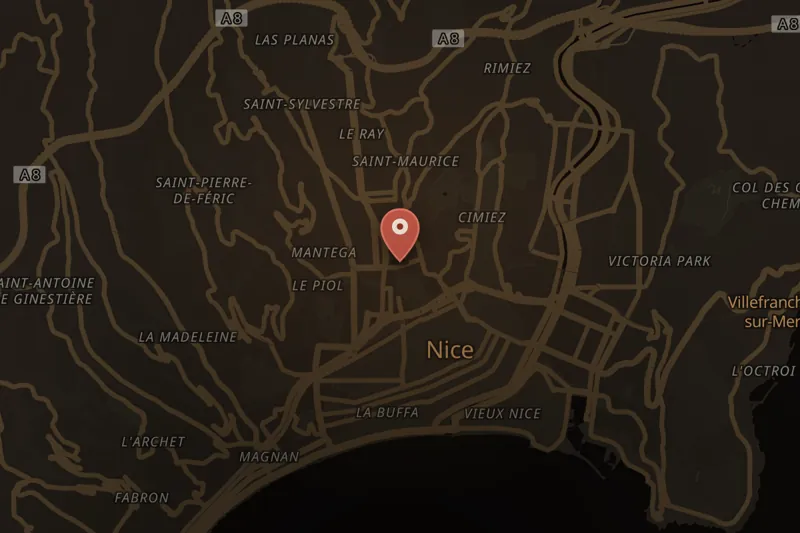
On the morning of 3 June 1974, eight-year-old Marie-Dolorès Rambla was playing with her younger brother and two other children in the car park of a multistorey garage on the Cité Sainte-Agnès housing estate in Marseille, France. Christian Ranucci, a 20-year-old door-to-door salesman travelling alone over the Pentecost weekend, had stopped in the area while looking for a former army comrade's home. He watched the children for thirty to forty-five minutes. Around 11:10 am, after the other children had left for lunch and Marie-Dolorès and her brother were briefly alone, Ranucci told them he had lost a dog, sent the boy to search for it, and persuaded Marie-Dolorès to get into his car by promising to bring her home in time for lunch.
About an hour later, Ranucci's car collided with another vehicle at a crossroads. He drove on toward Marseille, stopped after a few hundred metres, and led the girl into underbrush on a hillside. According to the confession he later gave investigators, he grabbed her by the neck, struck her head with stones, and stabbed her repeatedly with a folding knife before covering her body with brush. He then drove to a nearby mushroom farm, where he changed his damaged tyre and bloodied clothes and buried the knife in a peat stack; his car became stuck in mud there, and farm workers helped free it with a tractor before he returned home to Nice.
Witnesses to the earlier traffic collision had recorded Ranucci's license plate number, and he was arrested two days later, on 5 June 1974, as he returned home from work — shortly after gendarmes found the girl's body. Ranucci confessed to the abduction and killing, drew investigators an accurate sketch of the kidnapping, and directed them to the buried knife. Months later, while jailed at Marseille's Baumettes prison, he retracted the confession, and at trial his defense argued for his innocence.
Ranucci was tried in Aix-en-Provence on 9 and 10 March 1976. He denied the crime despite the physical evidence and the details he had earlier provided investigators. The jury convicted him on all counts on 10 March 1976 and sentenced him to death. The Court of Cassation rejected his appeal on 17 June 1976, and President Valéry Giscard d'Estaing declined to grant clemency on 26 July. Ranucci was executed by guillotine at Baumettes prison on 28 July 1976 — the third-to-last person executed in France before the country abolished capital punishment in 1981, though the case's notoriety has led some accounts to describe him as the last person executed.
The case became part of France's national debate over capital punishment. A 1978 book, Le Pull-over rouge by Gilles Perrault, argued that Ranucci had been wrongly convicted and sold more than a million copies, but three subsequent requests to reopen the case — the last rejected in 1991 — found no new facts casting doubt on his guilt. In September 1981, Minister of Justice Robert Badinter cited lingering public unease over the Ranucci case while urging the National Assembly to abolish capital punishment. Investigating commissioner Gérard Alessandra and four other police officers later won defamation judgments against Perrault over his published claims that they had mishandled the case.


 Credit: LewisiscrazyCC BY-SA 4.0SourceSOLVEDListen