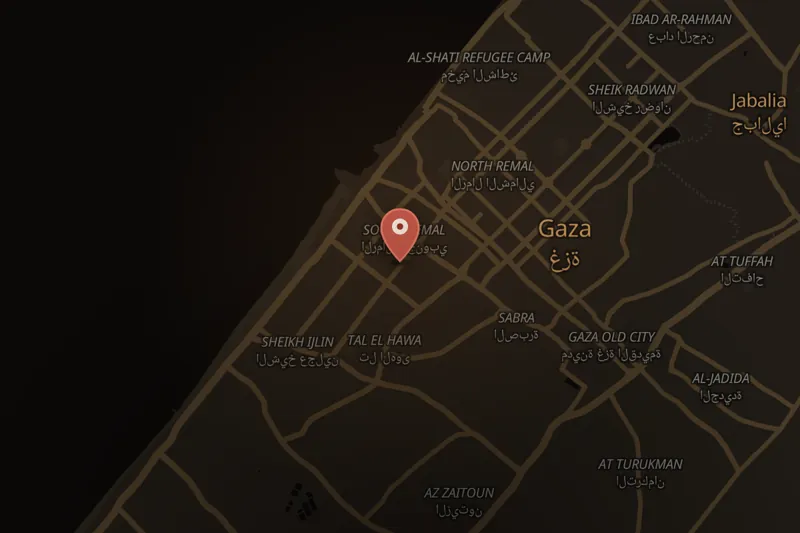
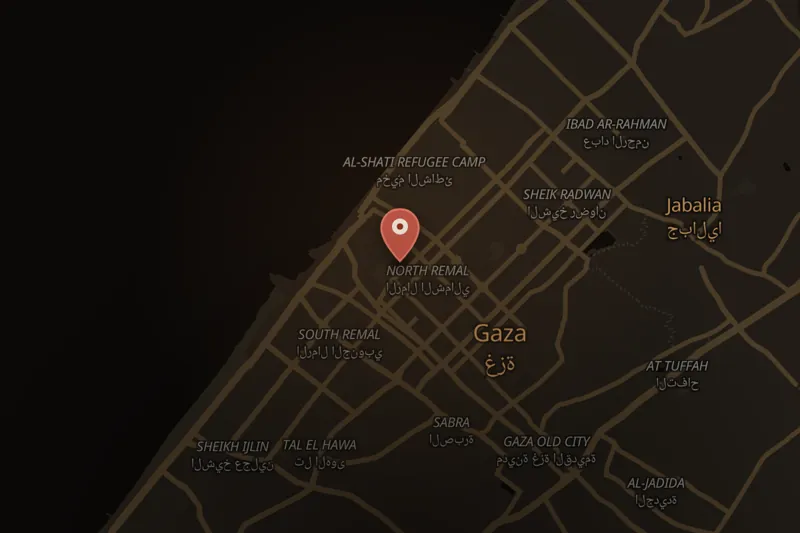
Hind Rami Iyad Rajab, a five-year-old Palestinian girl, was killed in the Gaza Strip on 29 January 2024 during the Gaza war. She and six family members were fleeing the Tel al-Hawa neighborhood of Gaza City when their vehicle, a black Kia, was shot by an Israeli army tank, killing her uncle, aunt, and three cousins. Her 15-year-old cousin, Layan Hamadeh, was the only other initial survivor and called the Palestine Red Crescent Society (PRCS) for help, reporting that a tank was next to the car and that they were being fired upon. Hamadeh was killed while still on the phone with dispatchers. Hind then took over the call, remaining on the line with PRCS for three hours, telling the dispatcher she was scared and asking to be rescued. Her grandfather later said she had been injured in the back, hand and foot.
PRCS coordinated with the Gaza Health Ministry and the Israeli military for safe passage of an ambulance to reach Hind. The ambulance crew reported being targeted with lasers before contact was lost after sounds of gunfire or an explosion. The fates of Hind and the paramedics remained unknown for 12 days until 10 February 2024, when family members returned after an Israeli military withdrawal and found the car with Hind, Hamadeh, and other relatives dead, and the Red Crescent ambulance destroyed nearby with paramedics Yusuf al-Zeino and Ahmed al-Madhoun also killed.
Israel initially stated no troops were in the vicinity and that ambulance coordination had been unnecessary. This account was disputed by multiple investigations. The Euro-Mediterranean Human Rights Monitor described the killings as a "planned execution" and reported that shell fragments of an American-made M830A1 projectile were found near the destroyed ambulance. An Al Jazeera investigation found three Israeli tanks in the vicinity at the time of the attack. A Washington Post investigation using satellite imagery, published in April 2024, found Israeli armored vehicles present near the scene and determined that damage to the ambulance was consistent with an Israeli tank round, while noting some uncertainty due to limited data on Hamas-made munitions. Sky News reported in October 2024 that satellite imagery showed at least 15 military vehicles in the neighborhood on the day of the attack, with the nearest just 300 meters from the ambulance site, and noted that a now-deleted IDF press release may have contradicted the military's denial. Forensic Architecture's June 2024 investigation concluded an Israeli tank likely fired 335 rounds at the family's car and that tank operators would have been able to see civilians, including children, inside; it also concluded a tank likely struck the ambulance. In July 2024, independent UN Human Rights Council experts said the killing might amount to a war crime. A case was submitted to the International Criminal Court by the human rights group Justice For All in February 2024, and the Hind Rajab Foundation filed a further war crimes complaint in May 2025 naming a battalion commander it identified. In September 2025, a UN Independent International Commission of Inquiry report on the Occupied Palestinian Territory cited Hind Rajab's killing as an example within its finding that Israel had committed genocide in Gaza.
The case drew international attention, including student protests at Columbia University and UC Berkeley that renamed campus buildings in her honor, criticism of Western media coverage, and commemorative artistic works.