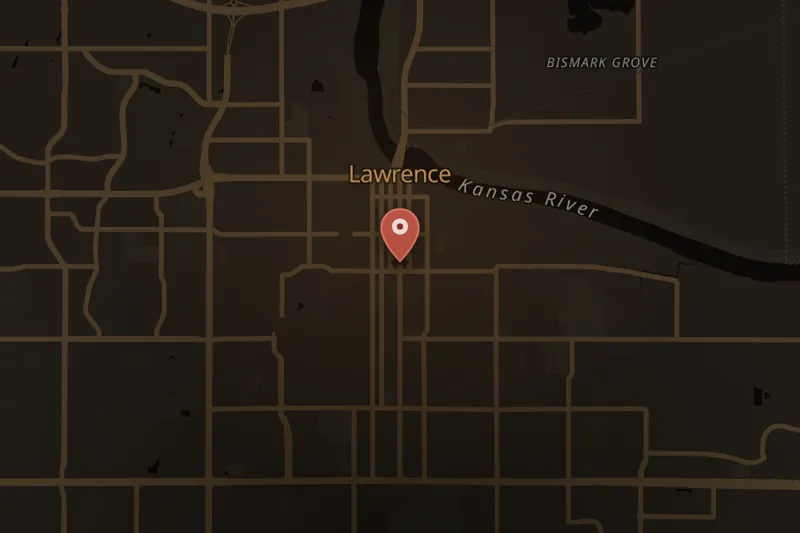
The Lawrence Massacre, also known as Quantrill's Raid, was an attack during the American Civil War on the morning of Friday, August 21, 1863, by Quantrill's Raiders, a Confederate guerrilla group led by William Quantrill, on the Unionist town of Lawrence, Kansas. The raid killed around 150 men and boys and left a quarter of the town's buildings pillaged and burned. Lawrence was targeted due to its long-standing support of abolition and its reputation as a center for Jayhawkers, free-state militia and vigilante groups known for attacking pro-slavery communities in western Missouri.
By 1863, Kansas had been the site of years of guerrilla warfare over slavery, a period known as "Bleeding Kansas." Lawrence had already been attacked once before, in 1856. Historians, including Albert Castel, conclude that revenge against Jayhawker leaders such as Charles "Doc" Jennison and James Montgomery was the primary motive for the 1863 raid, with plunder a secondary motive. Quantrill himself stated his goal was "to plunder, and destroy the town in retaliation for Osceola," referencing a 1861 Union attack on Osceola, Missouri, led by Senator James H. Lane. The collapse of a makeshift women's prison in Kansas City on August 13, 1863, which killed four women related to Confederate guerrillas, is also believed to have intensified the raiders' motivation, though the raid had reportedly been planned before the collapse occurred.
Around 450 guerrillas converged on Lawrence shortly after 5 a.m. on August 21. One of the first killed was Samuel S. Snyder, a pastor and lieutenant in the 2nd Kansas Colored Regiment, shot while milking cows. Raiders seized the Eldridge House hotel as a headquarters, then fanned out through the town for roughly four hours, looting banks and stores and killing over 150 people, all men and boys, in what witnesses described as more a mass execution than a battle. Raiders carried lists of targeted men, including Senator James H. Lane, who escaped, and newspaperman John Speer, whose two sons were killed. Accounts describe indiscriminate killings, including men and boys who had surrendered, a father killed in a field with his son, and two men forced into a burning building. The youngest reported victim, Bobbie Martin, was described in varying accounts as between ten and fourteen years old.
In the aftermath, Senator Lane pursued the raiders with survivors and about 200 U.S. Army cavalrymen under Major Preston B. Plumb, engaging them near Brooklyn, Kansas. A day after the attack, surviving citizens of Lawrence lynched a captured raider. On August 25, 1863, General Thomas Ewing Jr. issued General Order No. 11, evicting thousands of Missourians from four border counties, whose homes and property were subsequently burned by Jayhawker forces under Jennison. Quantrill led his men to Texas for the winter; his force disintegrated as a unified group the following year, and Quantrill died of wounds received in Kentucky in 1865. The U.S. Army later built several military posts on Mount Oread to guard the rebuilt town.


 SOLVEDListen