Case file
Potawatomi Trail of Death
Documents violence · crimes against children — written to inform, not to shock.

Overview
The Potawatomi Trail of Death refers to the forced removal, in 1838, of approximately 859 members of the Potawatomi nation from their reservation lands at Twin Lakes, Indiana, to newly designated reservation lands in what is now eastern Kansas. The march covered about 660 miles over 61 days and is recorded as the largest single Indian removal in Indiana's history. During the journey, more than 40 people died, most of them children.
Background
The Potawatomi had ceded most of their Indiana lands to the federal government through a series of treaties between 1818 and 1832. Under the Treaty of Tippecanoe (1832), Chief Menominee's band retained a 14,080-acre reserve at Twin Lakes. However, a subsequent Treaty of Yellow River (1836) purported to cede this reserve as well. Menominee and members of his band refused to sign this treaty and later petitioned General John Tipton and federal officials, including President Martin Van Buren and Secretary of War Lewis Cass, alleging that signatures on the 1836 treaty had been forged. No record exists of a formal reply to these petitions, and the federal government maintained its removal deadline of August 5, 1838.
The Removal and March
On August 30, 1838, Indiana Governor David Wallace's authorized militia, commanded by General John Tipton, surrounded the Potawatomi at their chapel at Twin Lakes under the guise of a council meeting, detaining tribal leaders. Between August 30 and September 3, 1838, the militia gathered Potawatomi from Twin Lakes and surrounding villages, burned crops, and destroyed the village of roughly 100 structures. The march began September 4, 1838, with 859 Potawatomi, 286 horses, 26 wagons, and roughly 100 armed militia escorts. Catholic missionary Father Benjamin Marie Petit joined the caravan, later securing the release of three chiefs—Menominee, Black Wolf, and Pepinawa—from being transported as prisoners in a wagon.
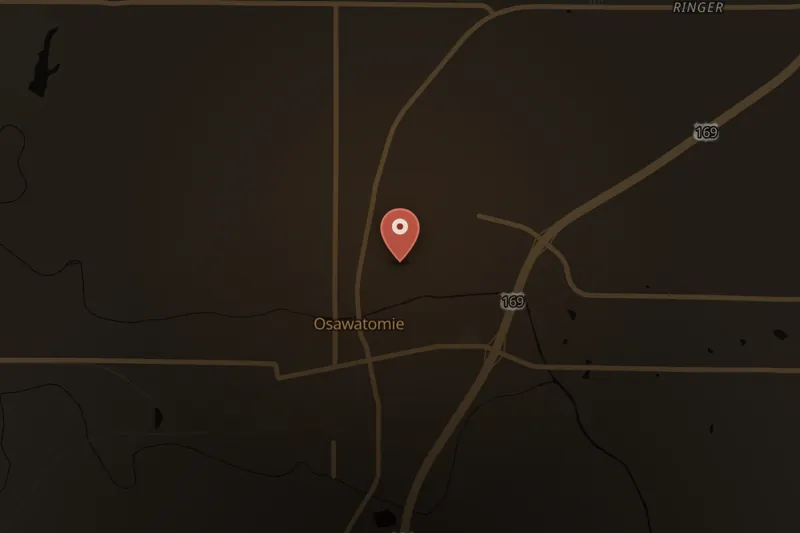
The route passed through Indiana, Illinois, and Missouri before reaching the western bank of the Osage River near present-day Osawatomie, Kansas, on November 4, 1838. Contemporary journals and letters, including those of Father Petit, Judge William Polke, and General Tipton, document daily deaths, illness, heat, and dust along the route. Of the 859 who began the march, 756 survived to the endpoint; 42 deaths were recorded, 28 of them children, with the remainder unaccounted for as escapees.
Aftermath
Chief Menominee died in Kansas in 1841 and never returned to Indiana. Father Petit, weakened by the journey, died in St. Louis in February 1839 while attempting to return home. The Potawatomi later relocated within Kansas and, following an 1861 treaty, some became the Citizen Potawatomi Nation, now headquartered in Shawnee, Oklahoma. The Trail of Death was designated a Regional Historic Trail by Indiana, Illinois, and Kansas in 1994, and by Missouri in 1996, with dozens of historical markers placed along the route.

Key facts
- Victims
- Benjamin Marie Petit, Menominee
- Date
- 1838
- Location
- Near Osawatomie, Kansas (end point); march began at Twin Lakes, Indiana
- Case status
- solved
Case timeline
1832-10
Treaties signed at the Tippecanoe River establish reduced Potawatomi reservation lands in Indiana, including the 14,080-acre reserve for Chief Menominee's band at Twin Lakes.
1836-08-05
Treaty of Yellow River signed, purporting to cede the Menominee Reserve; Chief Menominee and members of his band refuse to recognize it.
1837-11-04
Chief Menominee and other Potawatomi submit a petition to General John Tipton protesting the 1836 treaty as fraudulent.
1838-08-05
Federal deadline for Potawatomi removal from Indiana passes; Chief Menominee's band at Twin Lakes remains.
1838-08-06
Colonel Abel C. Pepper holds council at Menominee's village; Menominee refuses removal.
1838-08-30
General John Tipton's militia surrounds the Potawatomi at Twin Lakes under the guise of a council, detaining chiefs.
1838-09-03
Militia completes gathering of Potawatomi at Twin Lakes and destroys the village before departure.
1838-09-04
Forced march of 859 Potawatomi begins from Twin Lakes, Indiana.
1838-09-16
Caravan crosses into Illinois at Danville; Father Benjamin Marie Petit joins the march.
1838-10-10
Group crosses the Mississippi River from Quincy, Illinois, into Missouri.
1838-11-04
March ends on the western bank of the Osage River near present-day Osawatomie, Kansas.
1839-02-10
Father Benjamin Marie Petit dies in St. Louis, Missouri, while returning home.
1841-04-15
Chief Menominee dies in Kansas.
1994
Indiana, Illinois, and Kansas legislatures designate the Trail of Death a Regional Historic Trail.
1996
Missouri passes legislation designating the Trail of Death a Regional Historic Trail.
Best coverage
No approved coverage links are attached yet.
People
John Tipton
LAW ENFORCEMENTIndiana General who mobilized and led the militia that forcibly removed the Potawatomi from Twin Lakes and served as military escort for the march.
citation on file
Benjamin Marie Petit
VICTIMCatholic missionary who accompanied the Potawatomi on the forced march, tending to the sick and dying; died in 1839 from illness contracted during the journey.
citation on file
William Polke
LAW ENFORCEMENTFederal agent who conducted the Potawatomi caravan to Kansas and led the group after General Tipton returned to Indiana.
citation on file
David Wallace
LAW ENFORCEMENTIndiana governor who authorized General John Tipton to mobilize a militia to forcibly remove the Potawatomi.
citation on file
Menominee
VICTIMPotawatomi chief who refused to sign the Treaty of Yellow River and was forcibly removed from Twin Lakes, Indiana, to Kansas, where he died in 1841.
citation on file
Places
Common questions
- What happened to the victim?
- In 1838, Indiana militia forcibly removed about 859 Potawatomi people, led by Chief Menominee, on a 660-mile, 61-day march from Twin Lakes, Indiana, to Kansas; more than 40 people, most of them children, died along the way.
- Where did the crime happen?
- Near Osawatomie, Kansas (end point); march began at Twin Lakes, Indiana.
- What is the current status of the case?
- Status: solved. Last verified July 2026.
Sources
- Potawatomi Trail of Deathwikipedia · Wikipedia · 2026-07-07
- Potawatomi Treaty Text (Kappler Indian Affairs Collection)news · digital.library.okstate.edu · 2026-07-07
- Trail of Death — Sadorus Grove Encampmentnews · usd116.org · 2026-07-07
Last verified JUL 2026