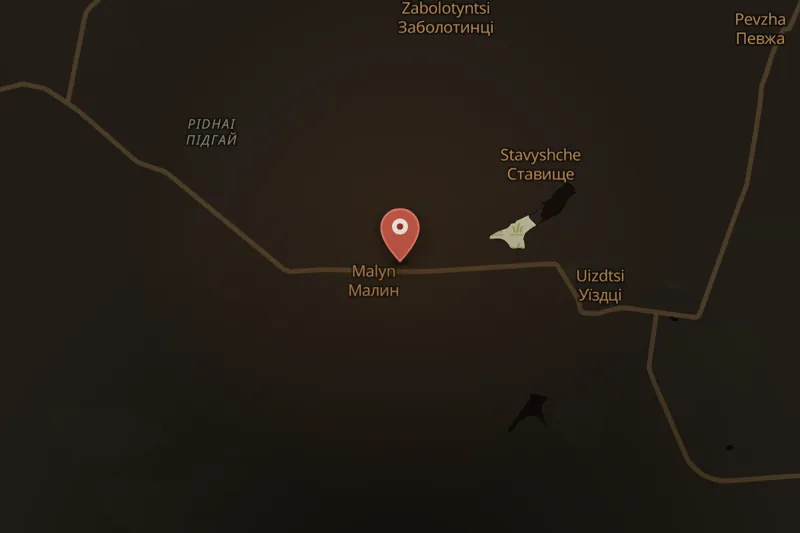
Malin was a village in the Dubien district of the former Volhynia Voivodeship, settled from the 1860s onward by Czech immigrants alongside an existing Ukrainian population, which led to the village splitting into two ethnic enclaves: Malin Czeski (Czech Malin) and Malin Ruski (Ukrainian Malin). By 1943 the area lay within German-occupied Reich Commissariat Ukraine. A week before the massacre, Soviet partisans under Sydir Kovpak briefly occupied the area and held a rally declaring the land part of the USSR; according to Władysław and Ewa Siemaszko, this visit is believed to have prompted the subsequent German punitive action, though historian Jared McBride states there is no evidence supporting the alternative theory that the village was targeted for supporting Ukrainian nationalist partisans.
On the morning of 13 July 1943, a punitive expedition — estimated by a Czechoslovak commission at roughly 1,500 men — arrived by car from Olyka. The attackers first opened fire on fleeing residents of Malin Ruski, then moved into Malin Czeski, where they went farm to farm under the pretext of checking documents, rounding up residents including children, the sick and the disabled. Captured people were marched to Malin Ruski, where they were sorted by sex, age and nationality. Most Czech women, children and elderly people were sent back to Malin Czeski and burned alive after being locked in barns. Around 50–80 people, mostly Czech men, were burned in a locked school building; about 155 people, mostly Ukrainian men, were killed with grenades and machine-gun fire inside an Orthodox church; roughly 90 women, children and elderly people were burned in two additional barns; and bedridden hospital patients were burned in another barn. A Czechoslovak commission led by Jaroslav Procházka, convened on the orders of General Ludvík Svoboda, later reported that women and children were killed while begging for their lives and that children were bayoneted and thrown into fires.
The Procházka commission's report put the death toll at 532 (374 Czechs, 132 Ukrainians, 26 Poles), while Soviet investigators recorded 603 deaths, including 194 men, 204 women and 205 children. A small number of people survived, including three who escaped burning buildings in Malin Czeski, 38–41 men and boys who were spared and sent away with looted property, and two individuals who hid during the massacre. Livestock was looted and 68 houses and 223 farm buildings were destroyed; the remains of victims were buried in a mass grave.
Responsibility for directing the massacre is attributed to German forces, including an SS unit, with named individuals identified by the Procházka commission as Friedrich Vogl, Martin Levandovský, and a policeman named Málek. The national composition of the collaborationist auxiliary police involved remains disputed among historians, with Ukrainian and Polish sources each attributing greater involvement to the other nationality; researchers including Motyka, the Siemaszkos, and McBride have stated that a definitive determination requires access to German documentation not yet available. The massacre has since been commemorated through multiple monuments in Malin and in Czechoslovakia, and has also been the subject of competing propaganda narratives, including Soviet-era accusations against Ukrainian nationalists and later Ukrainian nationalist leaflets blaming Polish-composed Schutzmannschaft battalions.


 Credit: PrymasalCC BY-SA 4.0SourceSOLVEDListen


