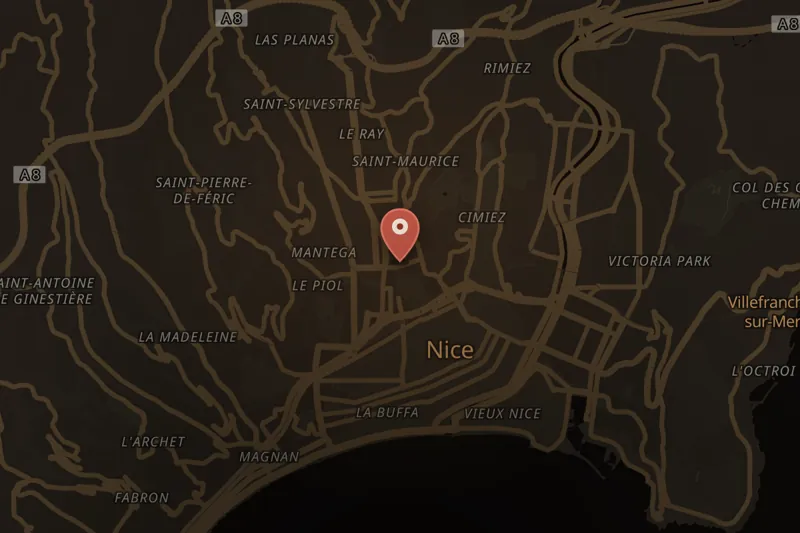
Agnès Marin was a 13-year-old boarding student in year four at the Collège Cévenol, a private school in Le Chambon-sur-Lignon, Haute-Loire, France. Her parents had enrolled her there that year because of bad influences at her previous school in Paris. A close friend described her as a good student who was interested in becoming a filmmaker.
On Wednesday, 16 November 2011, Marin went into nearby woods with a 17-year-old fellow student, Mathieu Moulinas, ostensibly to look for hallucinogenic mushrooms. Moulinas raped Marin, stabbed her, and burned her body. Her body was found two days later, on 18 November 2011. She was buried in Paris on 26 November 2011, the date that would have been her 14th birthday.
Moulinas, from Nages-et-Solorgues in Gard, was already under judicial supervision at the time of the murder. On 2 August 2010, he lured a 15-year-old acquaintance into a forest, tied her to a tree, and raped her; she later said she believed she would have been killed had her mother not called her mobile phone. After four months in detention on a charge of raping a minor with a weapon, experts who examined Moulinas certified him as 'redeemable,' and on 26 November 2010 a judge released him on remand on condition that he undergo psychological therapy, leave Gard, and board at Cévenol — the only school, of seventeen his parents approached, that would admit him. At the school he stood out for a gothic style of dress and boasts of hacking and drug use, and had poor grades; he was twice threatened with suspension in June 2011.
The murder, and the revelation of Moulinas's prior offense, prompted widespread criticism in France of the decision to release him into a co-educational boarding school and of the lack of disclosure to the school. His judicial supervisor said the presumption of innocence and professional ethics had constrained him from revealing Moulinas's history; the school said it had not known he was under judicial supervision. Marin's father said the school had been aware that Moulinas had problems involving 'sexual acts of aggression,' and at trial the school's director admitted that he had known. In late November 2011, the French government announced new rules requiring that juveniles accused of the most serious offenses be held in detention pending trial, and that schools receiving such juveniles be given full information about the alleged offenses beforehand.
Moulinas's trial opened before the Cour d'assises des mineurs (the juvenile assize court) on 18 June 2013, held in camera over the objections of Marin's family. Prosecutors cited numerous institutional failings in the case, asked the jury not to grant Moulinas the sentencing benefit of minority, and requested a 30-year sentence with civil commitment in light of his mental health history. On 28 June 2013, Moulinas was convicted of the 2010 rape and of the rape and murder of Marin, and sentenced to life imprisonment — only the second time a juvenile offender had received a life sentence in France; the first such sentence, imposed in 1989, was later overturned on acquittal. His lawyers announced plans to appeal. On 10 October 2014, the Appeal Assize Court confirmed the life sentence and added a lifelong care order, closing off further review of the factual rulings.
In 2016, Moulinas's parents published a book about their experience, which Marin's family publicly protested. In an interview, they said their son still expressed no remorse.


 SOLVEDListen