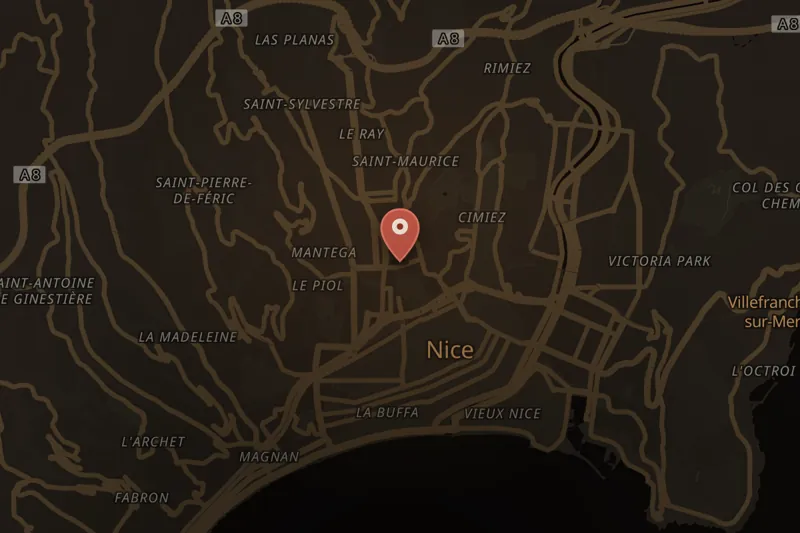
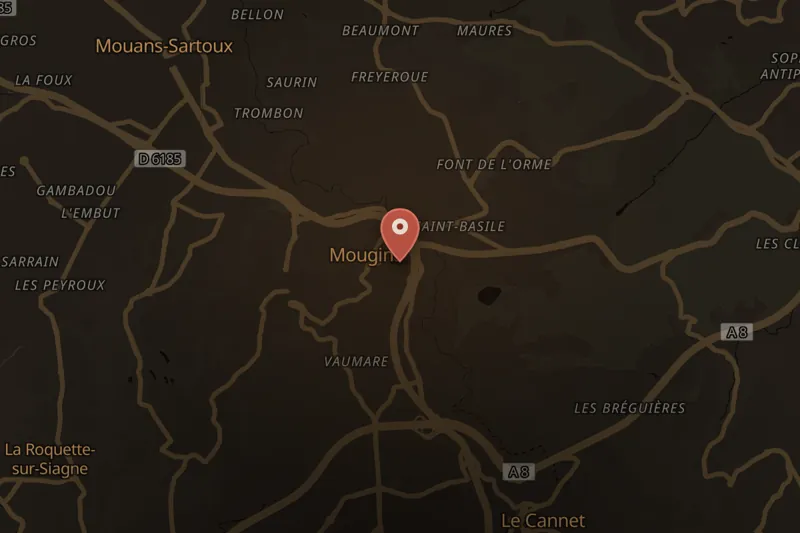
Ghislaine Marchal, born Ghislaine de Renty, was the daughter of an industrialist who took part in the French Resistance during the Second World War and died after being deported. By 1991 she was the wealthy widow of Jean-Pierre Marchal, whose company supplied equipment for automobiles. She divided her time between a residence in Switzerland and La Chamade, a villa she had built in the hills of Mougins, near Cannes, where she was killed.
On Sunday 23 June 1991, Marchal spoke briefly by telephone with a friend, saying she was hurrying to a lunch appointment. When another friend arrived at La Chamade the following day, 24 June, there was no answer. Friends alerted a security company, whose employee found the house dark and silent with no sign of a break-in; jewellery and an open handbag containing no money were later found inside. Police, called that evening, forced open a locked cellar door that had been blocked from the inside and discovered Marchal's body at the back of the cellar.
The autopsy of 28 June recorded severe injuries, including a fractured skull, a cut throat, a severed finger, and multiple stab wounds. Forensic assessments concluded that none of the wounds were immediately fatal and that Marchal survived for a short period. On a door nearby, written in blood, was the phrase 'Omar m'a tuer' - grammatically incorrect French for 'Omar killed me' - accompanied by a shorter, partial inscription elsewhere. Experts at the original trial concluded the blood was Marchal's and were 'two thirds' sure the handwriting was hers.
In 1994, Marchal's gardener Omar Raddad, a Moroccan-born man who spoke little French and was illiterate, was convicted of the murder and sentenced to 18 years in prison. He has consistently denied any involvement, and no DNA belonging to him was reported at the scene. Marchal's family said he had been refused an advance on his wages; Raddad stated that she had always treated him well. The case drew allegations of racism, including a remark the presiding judge directed at Raddad during the trial. After a request from Moroccan King Hassan II, French President Jacques Chirac granted a partial pardon in 1996, and Raddad was released in September 1998, though his name was not cleared.
Much of the later debate centred on the grammatical error in the blood inscription, although investigators found the same error in examples of Marchal's own writing. The original pathology report had given the date of death as 24 June, when Raddad had an alibi, before it was changed to 23 June as a correction of what was described as an error. Raddad was refused a re-examination of the evidence in 2002. In 2015, newer DNA testing revealed traces of several unknown males, and an expert for Raddad reported multiple DNA traces from at least one unknown source in the second inscription. An appeals court granted his request to reopen the case in December 2021, but in October 2022 an investigative commission rejected his request for a review of the trial.

 SOLVEDListen