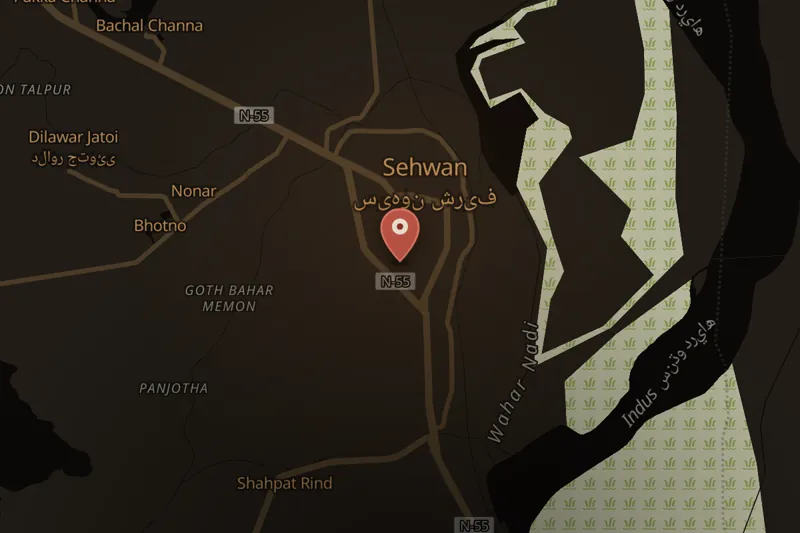
On the evening of 16 February 2017, a suicide bombing occurred inside the Shrine of Lal Shahbaz Qalandar in Sehwan, Sindh, Pakistan. The attack took place during a dhamaal, a Sufi ritual dance, performed by pilgrims after evening prayers. At least 90 people were killed and more than 300 were injured in the blast. The Islamic State of Iraq and the Levant – Khorasan Province (ISIL-KP) claimed responsibility for the attack.
According to accounts of the bombing, the attacker first threw a grenade that failed to detonate before he set off a suicide vest packed with ball bearings, which functioned as shrapnel and caused widespread casualties. He detonated the device inside the shrine hall beneath the dome, near the structure's Golden Gate, after bypassing the site's security checks. The bomber was believed to be an Afghan national. At least 21 children were reported among the dead.
The injured and dead were transported to Taluka Medical Hospital, a facility that lacked a trauma center equipped to handle mass casualties. A state of emergency was declared at hospitals in surrounding areas, and Pakistan Navy helicopters along with a Pakistan Air Force C-130 aircraft were deployed to assist with rescue operations. In the hours following the attack, Pakistani law enforcement launched a nationwide crackdown, during which more than 100 militants were reported killed and others arrested; confrontations occurred in Sindh and Khyber Pakhtunkhwa, and weapons including hand grenades were recovered. A suspected facilitator connected to the attack was arrested in Johi, a town in Sindh's Dadu District. On 22 February 2017, the Pakistan Military launched Operation Radd-ul-Fasaad, a countrywide operation aimed at eliminating terrorism.
In defiance of the attack, the shrine's caretaker resumed the daily tradition of ringing the shrine's bell the following morning, and the dhamaal ceremony resumed that same evening. Several days later, prominent Pakistani artists and performers took part in a dhamaal at the shrine as a symbolic response to the attack.
The bombing prompted strong domestic and international reaction. Pakistani Prime Minister Nawaz Sharif and Army Chief General Qamar Javed Bajwa condemned the attack, with Bajwa vowing retaliation. The Sindh government declared three days of mourning, and Khyber Pakhtunkhwa and Balochistan each observed a day of mourning. Pakistani military officials attributed the attack, along with a series of other early-February incidents including a suicide attack in Lahore, to jihadist elements operating from sanctuaries in Afghanistan. The Pakistan-Afghanistan border was sealed following the bombing, and Pakistan's military presented Afghan officials with a list of 76 alleged insurgents believed to be hiding in Afghanistan, demanding action. Pakistani forces subsequently struck alleged Jamaat-ul-Ahrar camps in Afghanistan's Nangarhar Province, an action confirmed by Afghan sources, and Afghanistan's foreign ministry protested the shelling. International leaders and governments — including those of Afghanistan, China, India, Japan, Russia, and the United States — issued statements condemning the attack and expressing condolences.

 Credit: Pax Ahimsa GethenCC BY-SA 4.0SourceSOLVEDListen


