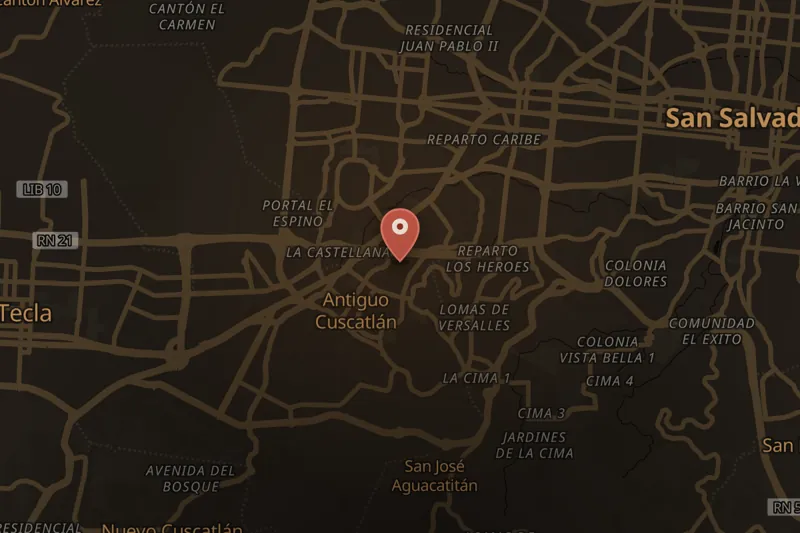
During the Salvadoran Civil War, on the night of 15–16 November 1989, members of the Salvadoran Army's Atlácatl Battalion killed six Jesuit priests and two women — a housekeeper and her 16-year-old daughter — at the Jesuits' residence on the campus of the Central American University (UCA) in San Salvador. The killings came amid rising tension between the government of El Salvador and the FMLN guerrilla movement, and after the FMLN had launched an offensive on the capital. Salvadoran military leaders had publicly accused UCA and its rector, Ignacio Ellacuría, of being aligned with FMLN "subversives" because of the Jesuits' advocacy for a negotiated peace and their focus on poverty and human rights.
According to the Salvadoran Truth Commission and the later Spanish court findings, Atlácatl Colonel Guillermo Alfredo Benavides Moreno met with subordinate officers the evening before the killings and ordered the elimination of Ellacuría and "known subversive elements," with instructions to leave no witnesses. Soldiers entered the Jesuit residence, ordered the priests to lie face-down in the garden, and then shot them. Housekeeper Elba Ramos and her daughter Celina Ramos were also shot. The soldiers staged the scene to resemble an FMLN attack, using a captured AK-47 and leaving a false-flag sign blaming the FMLN, before removing documents and cash from the residence.
The victims were Ignacio Ellacuría, Ignacio Martín-Baró, Segundo Montes, Juan Ramón Moreno, Joaquín López y López, and Amando López — all Jesuit priests and UCA employees — along with Elba Ramos and her daughter Celina Ramos.
The killings drew international condemnation, including from the U.S. government and Senator Claiborne Pell, and contributed to a reduction in U.S. military aid to El Salvador as well as the creation of a congressional investigation (the Moakley Commission) and a UN truth commission. The murders are widely regarded as a turning point that helped push the warring parties toward a negotiated peace settlement.
In El Salvador, nine soldiers were tried; only Colonel Guillermo Benavides and Lieutenant Yusshy René Mendoza were convicted, and both were released in 1993 under the Salvadoran Amnesty Law. The Truth Commission found that Salvadoran officials had concealed evidence to shield senior officers. In 2016, El Salvador's Supreme Court ruled the Amnesty Law unconstitutional, and Benavides returned to prison.
Separately, in 2008 the Center for Justice and Accountability and the Spanish Association for Human Rights filed suit in Spain against former Salvadoran president Alfredo Cristiani and 14 military members. In May 2011, a Spanish court convicted 20 Salvadoran military officers of murder, terrorism, and crimes against humanity, though Cristiani was not included in the ruling. One indicted officer, Inocente Orlando Montano Morales, was found living in Massachusetts; he was extradited to Spain in 2017 and, in September 2020, was convicted and sentenced to 133 years in prison for his role in the killings.
In 2023, the Archbishop of San Salvador announced the opening of a canonization process for the slain Jesuits and their household.


 Credit: Frankk785CC BY-SA 3.0SourceSOLVEDListen