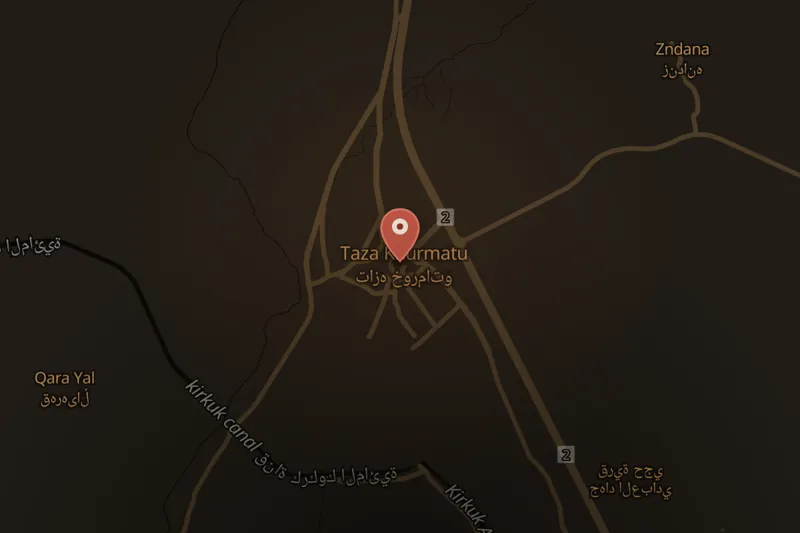
On 20 June 2009, a bombing struck the town of Taza, near Kirkuk in northern Iraq, an area with a dominant Shia Turkmen population. The attack occurred in a residential area near the Al-Rasoul mosque as worshippers were leaving following midday prayers. At least 73 people were killed and more than 200 were injured. Thirty homes, many built of mud-brick, were destroyed, and the explosion left a deep crater at the point of detonation; the nearby mosque was slightly damaged. The bombing was described as the worst attack in Iraq since March 2008, surpassing the twin suicide attacks that occurred in Baghdad and Muqdadiyah on 23 April 2009.
Survivors described the destruction and chaos that followed the blast. Hussain Nashaat, 35, told reporters he had been sitting in his house when a powerful blast shook the ground, leaving him covered in blood; he said his neighborhood was reduced to rubble. Some people were reported to have been buried alive in the collapsed structures. The injured were taken to Azadi Hospital in Kirkuk, with children placed in dedicated wards.
Following the bombing, the Kurdistan Regional Government, acting under orders from the Iraqi ministry of defence, launched a 15-day operation aimed at pursuing "terrorists and criminals" in the areas surrounding Kirkuk Province. Thirteen days after the attack, a high-ranking officer reported that a joint raid by Iraqi military forces and US troops in the town of Hawija had resulted in the arrest of a man identified as the mastermind behind two bombings in Kirkuk on 20 June. In December 2009, three men — Adnan Jassim Ali al-Hamdani, Walid Mahmoud Mohammed al-Hamdani, and Hawas Falah al-Juburi — were convicted and sentenced to death for helping to plan the attack.
The identity and affiliation of those responsible for carrying out the bombing were not definitively established in available reporting. Western media outlets, including Reuters, suggested the involvement of Sunni Islamist insurgents, including al Qaeda, though this was not confirmed.
The bombing drew strong condemnation from Iraqi and regional leaders. Iraqi Prime Minister Nouri al-Maliki called it an "ugly crime" intended to harm security and stability and to spread mistrust of Iraqi security forces. Kurdistan Regional Government president Massoud Barzani described it as a "coward act" aimed at disturbing fraternity and peaceful coexistence among Iraq's various communities. Turkey's Foreign Ministry issued a statement of "profound sorrow," condemning the attack as "heinous" and offering to receive injured victims for medical treatment, including via ambulance helicopter. The Turkmen Front announced three days of mourning and called for an immediate investigation and for those responsible to be brought to justice.

Key facts
- Victims
- On file
- Date
- 2009
- Location
- Taza, near Kirkuk, Iraq
- Case status
- solved
Case timeline
2009-06-20
A bombing near the Al-Rasoul mosque in Taza, near Kirkuk, Iraq, kills at least 73 people and injures over 200; 30 homes destroyed.
2009-07
A man identified as the mastermind of the 20 June Kirkuk bombings is reported arrested in a joint Iraqi-US raid in Hawija, roughly 13 days after the attack.
2009-12
Adnan Jassim Ali al-Hamdani, Walid Mahmoud Mohammed al-Hamdani, and Hawas Falah al-Juburi are convicted and sentenced to death for helping plan the attack.
Best coverage
No approved coverage links are attached yet.
People
Adnan Jassim Ali al-Hamdani
CONVICTEDConvicted and sentenced to death in December 2009 for helping to plan the attack.
Walid Mahmoud Mohammed al-Hamdani
CONVICTEDConvicted and sentenced to death in December 2009 for helping to plan the attack.
Hawas Falah al-Juburi
CONVICTEDConvicted and sentenced to death in December 2009 for helping to plan the attack.
Roles reflect public records and court outcomes at the time of writing — supporting citations are on file under Sources.
Archival records

archival location
US Army 51776 Workers repair a home damaged by a bomb blast in late June in the city of Taza, Iraq, Sept. 10. This is one of 150 homes that the United Nations provided funds to repair
Credit: Pfc. Justin Naylor, 2nd Brigade Combat Team, 1st Cavalry Division Public Affairs · Public domain · Source

unclassified
Taza begins recovery after bomb attack DVIDS184128
Credit: Spc. Justin A. Naylor · Public domain · Source

archival location
US Army 51775 Daniel Enders, the head of the United Nations High Commissioner for Refugees in Iraq, visits a home damaged by a bomb blast in the city of Taza, Iraq, Sept. 8. This home will soon be repaired with hel
Credit: Pfc. Justin Naylor, 2nd Brigade Combat Team, 1st Cavalry Division Public Affairs · Public domain · Source
Places
Common questions
- What happened to the victim?
- A truck/vehicle bombing near a mosque in Taza, a predominantly Shia Turkmen town near Kirkuk, Iraq, killed at least 73 people and injured over 200 on 20 June 2009, in one of the deadliest attacks in Iraq since March 2008.
- Where did the bombing happen?
- Taza, near Kirkuk, Iraq.
- Who was convicted?
- Adnan Jassim Ali al-Hamdani (Convicted and sentenced to death in December 2009 for helping to plan the attack.), Walid Mahmoud Mohammed al-Hamdani (Convicted and sentenced to death in December 2009 for helping to plan the attack.), and Hawas Falah al-Juburi (Convicted and sentenced to death in December 2009 for helping to plan the attack.).
- What is the current status of the case?
- Status: solved.
Sources
- 2009 Taza bombingwikipedia · Wikipedia · 2026-07-07
- Contemporaneous coverage — Reutersnews · Reuters · 2026-07-07
- Contemporaneous coverage — BBC Newsnews · BBC News · 2026-07-07