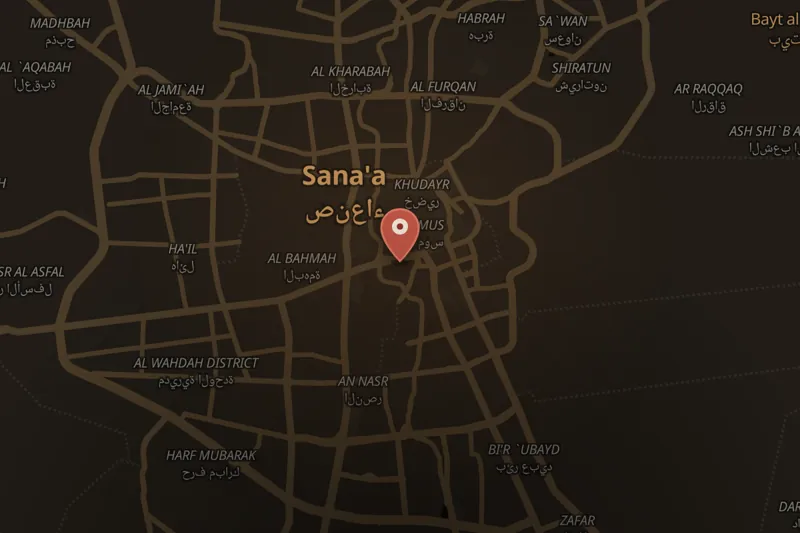
On 5 December 2013, a coordinated attack targeted the Ministry of Defense complex in Sanaa, Yemen. Gunmen dressed in army uniforms first opened fire on guards at the eastern gate, killing four guards and three militants. Minutes later, a suicide bomber drove a pickup truck loaded with roughly 500 kg of explosives through the western gate, detonating near the entrance of the al-Oradi hospital after being unable to reach his intended target due to gunfire from Yemeni forces. A second vehicle carrying twelve armed militants then breached the compound; the attackers split into two groups, with one occupying a laboratory and the other seizing the hospital. Within the hospital, gunmen killed soldiers, doctors, nurses, and patients, with witnesses describing militants shooting medical staff at close range and CCTV footage later showing a grenade thrown at a group of huddled doctors and nurses. Yemeni security forces engaged in an hours-long firefight, ultimately killing all militants involved by the afternoon, though some reports indicated fighting continued into the next day.
The attack killed 52 people and injured 167, with most casualties occurring in the hospital. Victims included 31 army officers, medical personnel, and seven foreign workers — two German aid workers, two Vietnamese doctors, two Filipino nurses, and one Indian nurse. Yemeni civilians killed included three doctors, five patients (among them a senior judge and his wife), a local aid worker, and a relative of President Abdrabbuh Mansur Hadi.
Ansar al-Sharia, an affiliate of al-Qaeda in the Arabian Peninsula (AQAP), claimed responsibility the following day, stating the ministry complex housed drone-control facilities and American personnel, which it considered a legitimate target. After state television broadcast hospital CCTV footage showing the killing of medical staff, public outrage followed, including among some AQAP sympathizers. On 21 December, senior AQAP leader Qasim al-Raymi issued a video apology for the hospital killings, saying the group had not ordered the assault on the hospital or mosque, offering condolences and blood-money payments to victims' families, while maintaining that the ministry itself was a legitimate target and vowing continued attacks on facilities linked to U.S. drone operations.
President Hadi ordered a military commission, led by Armed Forces Chief of Staff Ahmed al-Ashwal, to investigate. The commission's report suggested army sympathizers may have facilitated the attack and claimed seven of the militants were Saudi nationals who had entered Yemen using false identities; Amnesty International described this claim as unsubstantiated. Yemeni forces arrested several suspects in the following days, including two AQAP members identified as cell leaders, located via cellphone GPS tracking. On 12 December, a Yemeni judge charged three Saudi nationals with illegally entering the country to join AQAP after their arrest in Amran.
International reactions included condemnation from Germany, the Philippines, Vietnam, the United States, the United Kingdom, and the United Nations, several of which also announced enhanced security measures or evacuations of their citizens from Yemen. The Philippines subsequently banned new labor migration to Yemen.


 SOLVEDListen


