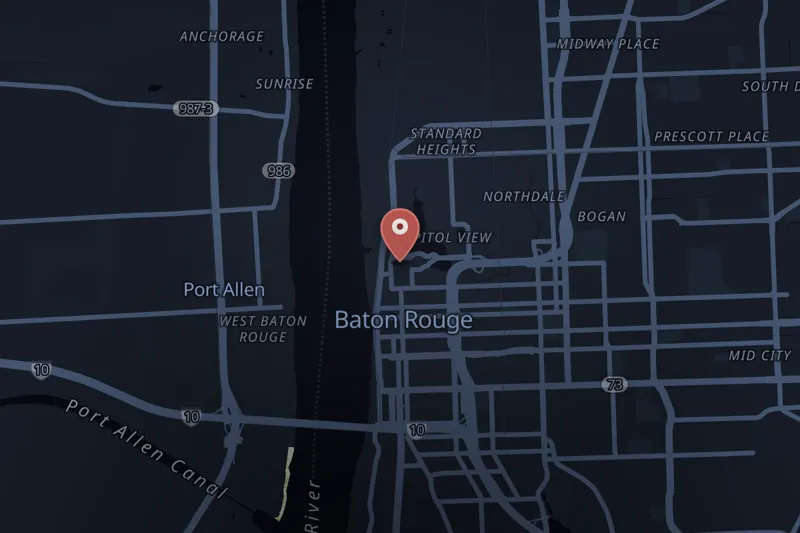
On September 8, 1935, Huey Long, a sitting United States senator and former governor of Louisiana, was fatally wounded at the Louisiana State Capitol in Baton Rouge. Long, a nationally prominent critic of President Franklin D. Roosevelt and leader of the Share Our Wealth movement, had traveled to the capitol to secure passage of a redistricting bill intended to remove opposition judge Benjamin Henry Pavy from office. Shortly after the bill passed, Long was confronted in a capitol corridor by Carl Weiss, Pavy's son-in-law, a 28-year-old ear, nose, and throat specialist with no prior political involvement.
According to the most widely accepted account, Weiss fired a single shot from an FN Model 1910 pistol, striking Long in the torso. Long's bodyguards, known as the "Cossacks," immediately opened fire on Weiss, killing him; witnesses estimated he was struck more than sixty times. Long was able to flee the corridor and was taken to Our Lady of the Lake Hospital, where surgeons operated to repair perforations to his intestines. His condition initially appeared to improve, but he began hemorrhaging from a kidney the next day and was judged too weak for further surgery. Long died at 4:10 a.m. on September 10, 1935, thirty-one hours after being shot. No autopsy was performed on either Long or Weiss at the time.
Substantial controversy surrounds the precise cause of Long's wound. An alternative theory, supported by a contemporaneous affidavit from a nurse who treated Long and by a 1935 investigative report commissioned by Long's life insurance company, holds that Weiss punched but did not shoot Long, and that Long was instead struck by a bullet fired by his own bodyguards during the chaotic gunfire directed at Weiss. This theory gained further attention after Weiss's body was exhumed in 1991 for forensic examination by pathologists at the Smithsonian Institution, who documented the trajectory and number of wounds on his remains. Ballistics analysis of a recovered bullet and Weiss's pistol, located in a safe-deposit box in 1991, led investigators to conclude the bullet had not been fired from Weiss's weapon, though it also could not be conclusively matched to a bodyguard's larger-caliber weapon. Historian T. Harry Williams, in his Pulitzer Prize-winning biography of Long, rejected the alternative theory, concluding that witness accounts supported Weiss as the shooter.
A state inquest held on September 16, 1935, heard testimony only from Long supporters and did not examine ballistic or medical evidence; a federal investigation found no evidence of a broader political conspiracy. Long's death removed him as a potential 1936 presidential challenger to Roosevelt and contributed to the collapse of the Share Our Wealth movement. Over 200,000 people reportedly attended his funeral, and he was buried on the grounds of the Louisiana State Capitol.


 Credit: Hattori family, via English WikipediaEditorial useSourceSOLVEDListen