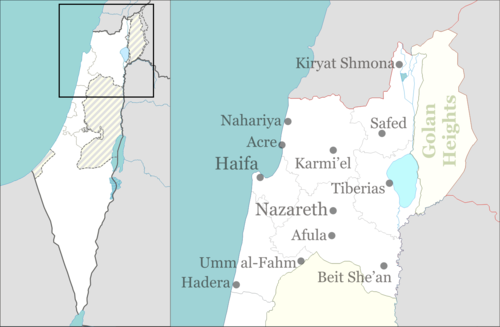
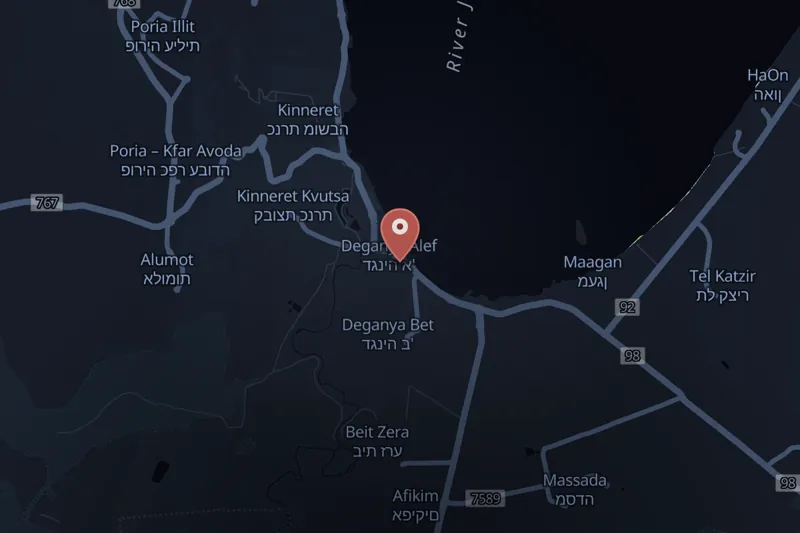
Moshe Barsky was born in 1895 in Skvyra, in the Kiev Governorate of the Russian Empire. In 1912, he immigrated to Ottoman Palestine along with his sister. He became a member of Degania Alef, which was founded in 1910 as the first kibbutz established by Jewish Zionist settlers.
On 22 November 1913, at age 18, Barsky was killed by Bedouin raiders. He had set out alone on a mule to obtain medicine from Menahemia for a fellow kibbutz member, Shmuel Dayan, who was ill. When the mule returned without him, kibbutz members organized a search and discovered his body later that night. According to the memoir of a fellow kibbutznik, Barsky was found "lying with a stick and a pair of shoes on his head," which was understood as a sign of vengeance, indicating that in the course of the attack he had killed or wounded one of his assailants. Sources describing the killing note signs indicating the murder was likely committed as an act of revenge.
Barsky's father, a Zionist living in Kyiv under Tsarist Russia, wrote a letter to the kibbutz following his son's death, urging its members not to lose spirit or retreat, and expressing hope that the memory of his son would provide strength to continue the work for which he had died. This letter became the focus of a 1914 speech delivered by Chaim Weizmann, who used it to urge European Zionists—shaken by the killing—not to abandon efforts to build a Jewish homeland in Palestine. Shortly after Barsky's death, his brother immigrated to Palestine to join Degania Alef.
Barsky quickly became a symbol within the Zionist movement, and various myths grew around his life and personality in the years following his death. Moshe Dayan, the prominent Israeli politician and public figure, was named after Barsky by his parents, who were fellow members of the kibbutz; Dayan later pointed to Barsky's death as part of the reasoning for establishing a Jewish state. Literary scholar Rachel Havrelock has analyzed the memorialization of Barsky as part of a broader Zionist narrative in which danger was associated with the region east of the Jordan River, with the river itself serving as a symbolic line between danger and safety. Havrelock also notes that the manner of Barsky's death—understood by contemporaries as having involved him killing one of his attackers—contributed to an image contesting the perception of Jews as being easily killed in the eyes of Bedouin. Historians and scholars have since recognized Barsky's death as a notable element of pre-Israeli Zionist ethos and mythology.


 SOLVEDListen