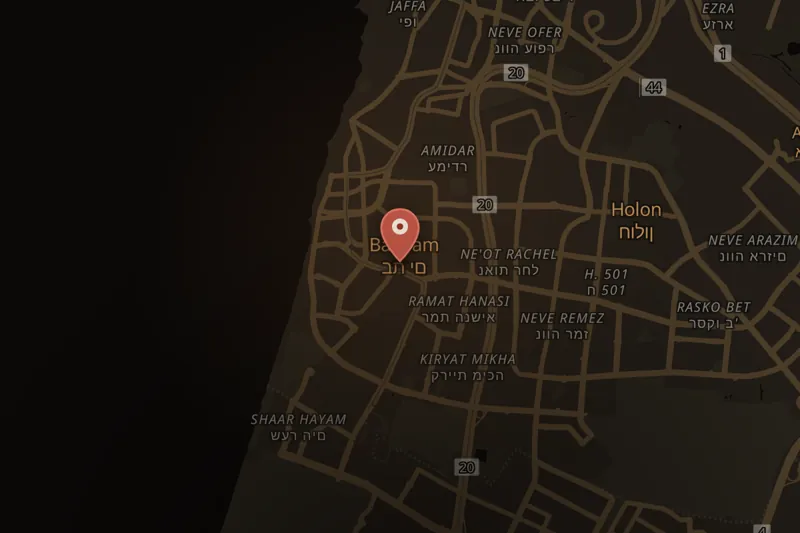
Nava Elimelech was an 11-year-old girl, the younger daughter of Makhlouf and Mazal Elimelech, who lived in Bat Yam, Israel. On 20 March 1982 she left her family's home to visit a friend who lived about 300 meters away, leaving a note asking her parents not to worry and promising to return. Her 19-year-old sister was the last person to see her alive. When she did not arrive at the friend's house, her family reported her missing and a police search began that evening. Over the following days, police and thousands of civilian volunteers searched the Gush Dan area; her photograph was circulated, tracking dogs were used, and neighborhood residents were questioned. On the tenth day of the search, people on the beach at Herzliya found her head in a plastic bag, and further remains were found near Tel Baruch beach in northern Tel Aviv. A pathologist concluded she had been killed on the day she disappeared, and she was buried in the southern cemetery in Bat Yam.
Police assembled a special team of about 40 investigators, described at the time as the largest in the history of the Israeli police. Investigators reported having little to work with, as no weapon or physical evidence was recovered at the scene, and some remains were sent to a laboratory in London in an attempt to identify the weapon. In June 1983 police described the case as a dead end. Tracking dogs led investigators to the home of a local resident who had once worked with the victim's father and lived near the family; a search found photographs of the victim and her friends but nothing linking him to the killing, though he was later convicted of an unrelated offense involving photographs of schoolchildren. In 1998 two brothers were arrested as suspects after the former wife of one of them reported that he had confessed; their property was searched and excavated, but no evidence was found and both were released.
Several theories were pursued over the years. In January 1983 a Gaza resident was arrested and released for lack of evidence, and the Chief of the General Staff at the time publicly suggested the killing was carried out by a nationalist organization, a claim about which senior police, including chief Arie Ivtsen, expressed reservations. In a 2001 radio interview, former investigator Yitzhak Gatnio said the Shin Bet had received information from an informant pointing to a nationalist motive, involving a man who had reportedly since died in Jordan. Former police commander and criminologist Avi Davidowicz later argued that Elimelech may have been one victim of a single offender responsible for a series of child disappearances in the Tel Aviv area between 1974 and 1994.
On 4 August 2019 police announced that, with court approval, they had exhumed Elimelech's remains for renewed testing at the Abu Kabir Forensic Institute, citing advances in DNA technology. Roughly 100 detectives were assigned, a profile of a possible suspect was compiled, and a gag order was imposed. Later that month police returned a pair of the victim's earrings to her family, and a former suspect was called in for questioning, although police indicated he was not considered a suspect. The killing remains unsolved.

 Credit: Avi1111 dr. avishai teicherCC BY 3.0SourceSOLVEDListen