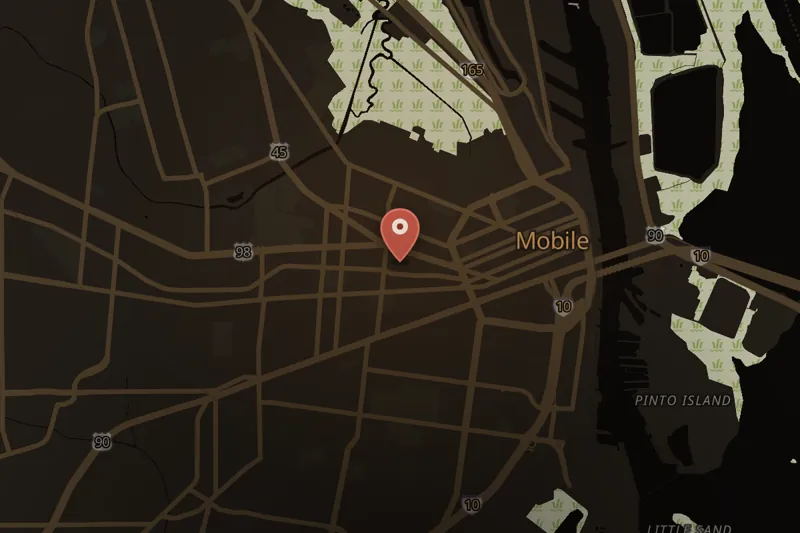
Michael Anthony Donald was a 19-year-old African-American man living in Mobile, Alabama, who was studying at a technical college and working at the Mobile Press Register. On the night of March 20–21, 1981, following a mistrial in the murder case of an African-American defendant, Josephus Anderson, members of United Klans of America (UKA) Unit 900 expressed anger over the outcome. Henry Hays, son of senior UKA official Bennie Jack Hays, and 17-year-old James "Tiger" Knowles drove through a predominantly Black neighborhood in Mobile looking for someone to attack. They encountered Michael Donald, who had no connection to the Anderson case, walking home after buying cigarettes for his sister. The two men lured him into their car under the pretext of asking for directions, then forced him at gunpoint to a wooded area near Mobile Bay.
Donald attempted to escape but was caught, beaten with a tree limb, and strangled with a rope by Hays while Knowles continued beating him. After Donald stopped moving, Hays cut his throat. The men hung his body from a tree on Herndon Avenue, across from Hays's home, where it remained until the next morning. The same night, two other UKA members burned a cross at the Mobile County courthouse.
An initial police investigation led to the brief detention of three men based on a tipster's account; the tipster was later convicted of perjury and sentenced to life as a habitual offender, and the three suspects were released. Michael Donald's mother, Beulah Mae Donald, sought help from Rev. Jesse Jackson, who organized a protest. Assistant U.S. Attorney Thomas Figures pressed for a renewed FBI investigation, working with agent James Bodman. In 1983, Henry Hays and James Knowles were arrested. Knowles confessed and later pleaded guilty to federal civil rights violations, receiving a life sentence from U.S. District Judge William Brevard Hand after testifying against Hays and others. Henry Hays was convicted of capital murder; a judge overrode the jury's recommendation of life imprisonment and imposed a death sentence. Hays was executed in Alabama's electric chair on June 6, 1997 — the state's first execution for a white-on-black crime since 1913, and the only 20th-century execution of a Klansman for killing an African American.
Benjamin Franklin Cox Jr., who had supplied the rope and a pistol, was initially discharged due to a statute-of-limitations issue but was reindicted for murder in 1987 and convicted as an accomplice in 1989, receiving a life sentence; he was paroled in 2000. Bennie Jack Hays was indicted for inciting the murder, but his criminal case ended in mistrial after he collapsed in court, and he died before retrial.
Beulah Mae Donald, assisted by Morris Dees of the Southern Poverty Law Center and attorney Michael Figures, filed a wrongful death civil suit against the UKA in 1984. In 1987, an all-white jury found the UKA liable and awarded $7 million in damages, a judgment that bankrupted the organization and set a precedent for civil actions against hate groups. Beulah Mae Donald died on September 17, 1988. In 2006, Mobile renamed Herndon Avenue in Michael Donald's honor.

 SOLVEDListen