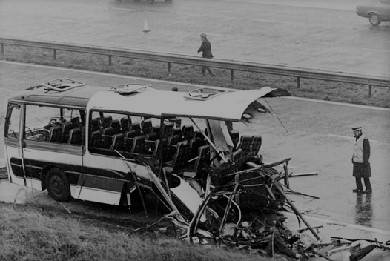
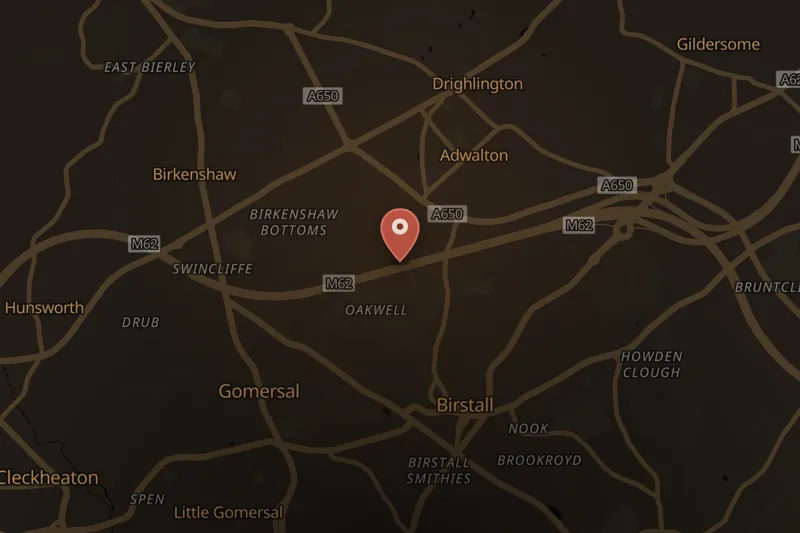
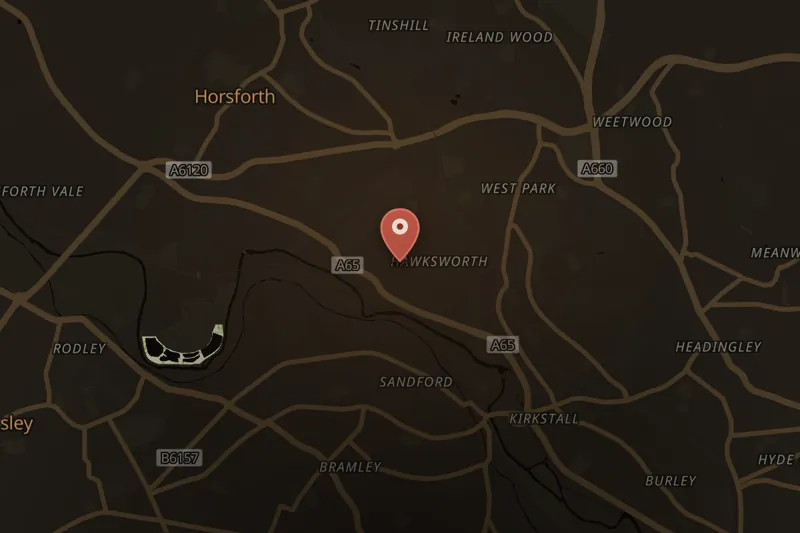
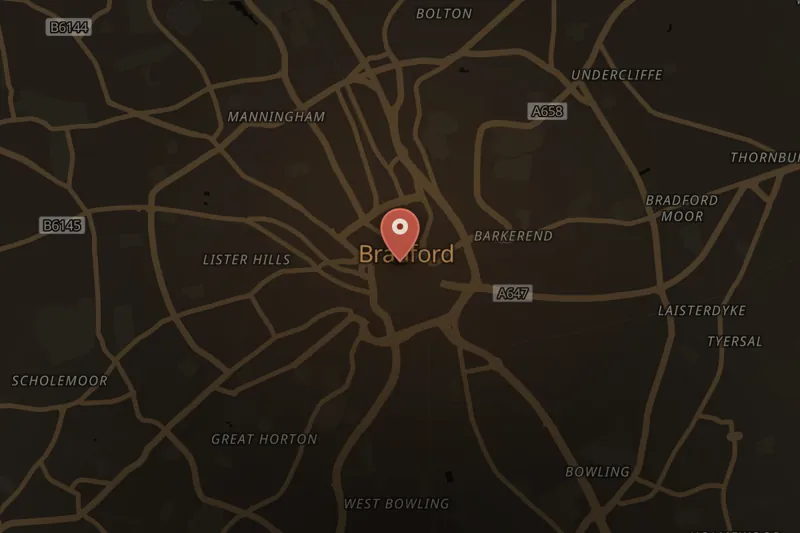
On the night of 3–4 February 1974, a coach carrying British Army and Royal Air Force personnel and their families back to Catterick and Darlington bases exploded shortly after midnight on the M62 motorway between junctions 26 and 27. A 25-pound (11 kg) bomb, concealed in the luggage compartment, had been planted by the Provisional Irish Republican Army. The explosion killed eleven people outright, with a twelfth victim dying four days later, and injured thirty-eight others. Among the dead were nine soldiers—two from the Royal Artillery, three from the Royal Corps of Signals, and four from the 2nd Battalion Royal Regiment of Fusiliers—and three civilians, including an entire family: Corporal Clifford Haughton, his wife Linda, and their sons Lee and Robert, who had been seated directly above the bomb. Driver Roland Handley, though injured, managed to steer the coach to a halt on the hard shoulder after the blast. Nearby Hartshead Moor service station was used as an impromptu first aid station.
The bombing prompted a strong public and political reaction, with the BBC and national newspapers describing it as one of the IRA's most severe mainland attacks. In Northern Ireland, the Ulster Defence Association responded with revenge attacks on Catholic civilians. IRA Army Council member Dáithí Ó Conaill later stated the coach had been targeted based on intelligence that it carried only military personnel.
Ten days after the bombing, police detained Judith Teresa Ward, a 25-year-old woman with a documented personality disorder, in Liverpool. Forensic tests conducted by scientist Frank Skuse indicated trace nitroglycerin on her hands and possessions. Ward went on to make a series of confessions to the bombing and two other non-fatal IRA attacks, though these confessions contained demonstrable inaccuracies—including a claim about her physical location at the time of the bombing that was later disproved by more than a dozen independent witnesses. She was tried at Wakefield Crown Court beginning 3 October 1974 and convicted on 4 November 1974 of all charges, receiving a sentence of life imprisonment with a minimum term of thirty years.
Ward's conviction was reviewed multiple times between 1985 and 1989, each review identifying serious evidential flaws. In 1991 the Home Secretary referred her case to the Court of Appeal. In May 1992, the Court of Appeal found that scientific evidence had been unreliable and that police, forensic experts, psychiatrists and prosecutors had withheld substantial exculpatory evidence from her defence. The court ruled her conviction "a grave miscarriage of justice" and Ward was released on bail on 11 May 1992; her conviction was formally quashed on 4 June 1992. She had served over seventeen years of her sentence. The actual perpetrators of the M62 coach bombing were never arrested or convicted. The case contributed to the introduction of stricter UK anti-terrorism laws, and memorials to the victims have since been erected at Hartshead Moor service station and in Oldham.