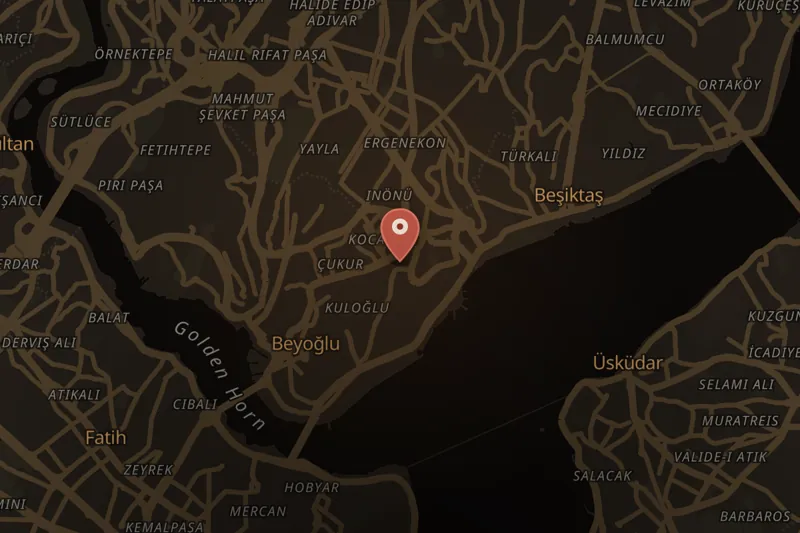
On 19 March 2016, at approximately 10:55 local time, a suicide bombing occurred in Istanbul's Beyoğlu district near the intersection of Balo Street and İstiklal Avenue, a major shopping street, directly in front of the district governor's office. The attack killed at least five people, including the perpetrator, and injured 36 others, seven of them severely. Twelve of the injured were foreign tourists.
The bombing was the fourth suicide bombing in Turkey in 2016 and came six days after a bombing in Ankara that had killed 37 people. In the run-up to the attack, the United States embassy in Ankara had issued a terrorism warning covering Istanbul, Ankara, İzmir, and Adana, and the German embassy had issued its own security warning and temporarily closed its consulate on İstiklal Avenue. Turkish Prime Minister Ahmet Davutoğlu described the warnings as "normal." According to Turkish media reports, the government faced criticism on social media afterward over perceived security failures.
At the time of detonation, İstiklal Avenue was relatively quiet compared to its usual crowds. An eyewitness said the bomber detonated the device while passing a group of tourists. Nails and metal fragments were scattered across the site. Differing accounts described the bomber's intended target: a CNN Türk reporter said the attacker was en route to another target when the device went off in front of a restaurant, while a Turkish official cited by Reuters said the bomber had been "deterred" by police and detonated the device "out of fear."
Among the dead were three Israeli nationals — two of them dual American-Israeli citizens — identified as Yonatan Suher (40), Simcha Dimri (60), and Avraham Goldman (69). An Iranian national, Ali Reza Razmkhah (45), was also killed; his young children and another Iranian woman were among the injured. A Turkish family, the Başarans from Adana, were also injured, including a 2.5-year-old child struck in the head by a metal fragment and her mother, who sustained life-threatening injuries.
Initial assessments by Turkish authorities pointed toward Kurdish militant involvement, given the proximity to the earlier Ankara bombing, but investigators shifted their assessment later the same day to hold the Islamic State of Iraq and the Levant (ISIL) responsible. On 20 March, Turkish authorities announced that DNA testing had identified the suicide bomber as Mehmet Öztürk, born in 1992 in Gaziantep Province, who was believed to be affiliated with ISIL. Öztürk had reportedly left home in 2013 and was later reported missing; he purchased a bus ticket to Istanbul from Adıyaman on 18 March and arrived the day of the attack. A second Turkish national, described as an ISIL militant also linked to earlier bombings in Ankara, was separately named by Turkish media as a suspect; his parents were briefly arrested and later released. On 22 March, the Turkish interior minister stated the bomber had links to ISIL.


 Credit: KurmanbekCC BY-SA 4.0SourceSOLVEDListen