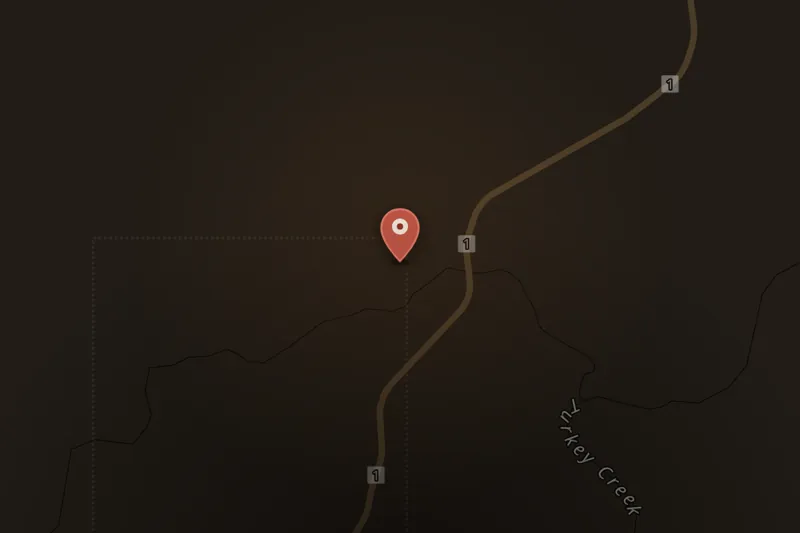
On 28 March 1915, a group of between 8 and 32 Gija people were shot and killed at Mistake Creek in the East Kimberley region of Western Australia, and their bodies were subsequently burned. Exactly who was responsible and why the massacre occurred remain uncertain, but the perpetrators are believed to have been Michael "Mick" Rhatigan, a former police constable then working as a telegraph linesman at Warmun (then called Turkey Creek), along with two of his Indigenous employees, known as Jim Wynne and Nipper. Rhatigan had reportedly been involved in earlier massacres of Aboriginal people during his time as a police constable, including one in 1895 in which around 20 people were killed.
According to Gija oral history, the massacre was carried out because of a mistaken belief that people in the attacked camp had killed and eaten one of Rhatigan's milking cows. Oral accounts state that Rhatigan was directly involved, with Wynne and Nipper assisting, and there is some suggestion that Wynne encouraged the massacre, possibly connected to a dispute over a woman. This oral history is understood to derive from accounts given by survivors.
In the aftermath, Rhatigan and Nipper were arrested. Wynne was shot dead by police after he was seen near one of the bodies and ran when ordered to surrender; his death was ruled a "justifiable homicide," and the constable who killed him was commended by a jury for his "promptness," with Wynne described as "a most dangerous character." A coroner's inquest held at Turkey Creek acquitted Rhatigan of any wrongdoing, while Nipper was ordered to stand trial for the murder of eight people. Nipper was found not guilty and released, later working at the police stables in Perth. Rhatigan remained a telegraph linesman at Turkey Creek until his death in 1920; his son John Rhatigan later became a long-serving Labor politician in the Western Australian Legislative Assembly.
The events have been subject to differing historical accounts. In 2001, following a visit by then-Governor-General William Deane to the massacre site, commentary arose regarding the roles of Rhatigan, Wynne, and Nipper, with historian Keith Windschuttle asserting no Europeans were involved and that the killings stemmed solely from a dispute over a woman between Wynne and Nipper. This account was disputed by Western Australian historian Cathie Clement, who challenged both Windschuttle's characterisation of Deane's visit and his interpretation of the oral history record. Later research has given greater weight to Gija oral and visual histories, which had previously often been dismissed in favour of colonial-era accounts.
Gija artists from the Warmun community have depicted the massacre in artworks. A painting by Aboriginal artist Queenie McKenzie depicting the massacre was acquired by the National Museum of Australia in 2005 but was initially withheld from display over a dispute about whether the depicted event had occurred; it was eventually exhibited in July 2020 as part of the "Talking Blak to History" exhibition.

 Credit: BlondhairGirlCC BY-SA 3.0SourceSOLVEDListen