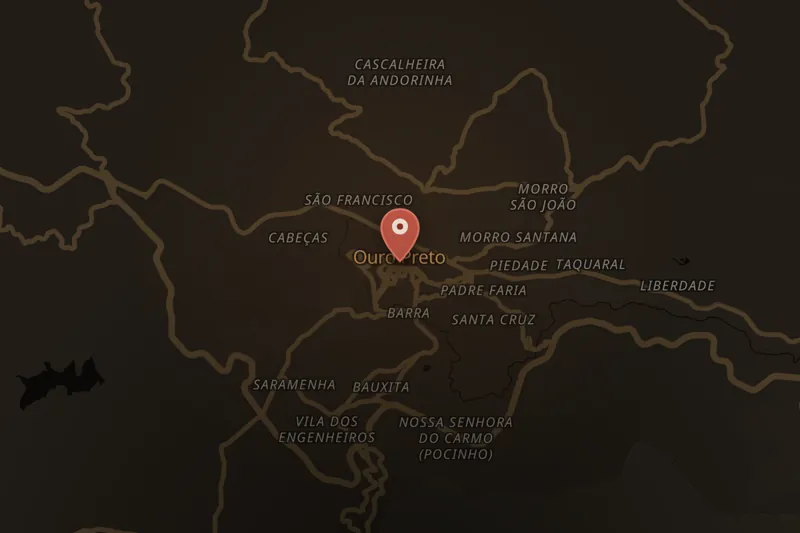
In October 2001, student Aline Silveira Soares traveled from her hometown of Guarapari, in the state of Espírito Santo, to the historic city of Ouro Preto, Minas Gerais, home to the Federal University of Ouro Preto (UFOP). She was reportedly accompanied by a friend named Liliane and her cousin, Camila Dolabella. The group attended "Do Doze," an annual university festival held on 12 October that brings together UFOP alumni and students.
At dawn on 14 October 2001, Aline was found dead on a grave in the "Nossa Senhora das Mercês" cemetery. Her body showed signs of 17 stab wounds. Investigators and much of the mainstream media at the time advanced the claim that the death was connected to students playing role-playing games, including Dungeons & Dragons and Vampire: The Masquerade; the latter game was temporarily banned by a Brazilian court. Prosecutors alleged that Aline had been killed by three residents of the Sonata república, a student house where the young women had stayed overnight for the festival, and that the motive stemmed from an RPG session she had lost, framing the killing as a ritual act tied to purported Satanic precepts.
The three men accused of the murder stood trial and were acquitted on 5 July 2009, following five days of proceedings.
Subsequent academic analysis examined the media's and judiciary's handling of the case. Cynthia Semíramis Machado Vianna, a law scholar (PhD, Universidade Federal de Minas Gerais), has written that press coverage promoted disinformation during the years leading up to the trial, constructing an unsupported link between RPGs and black magic or Satanic ritual. She pointed to a December 2004 broadcast on the television program Jornal da Globo, in which journalists described "black magic books" and a "satanic bible" found among the defendants' belongings, while the footage shown depicted RPG sourcebooks — including a Vampire: The Masquerade supplement titled Book of Nod, a work of fictional, poetic material about a fictitious biblical origin for vampires. Vianna has argued that this coverage stigmatized RPG players nationally and that, after the acquittal, media outlets shifted focus away from their own role in the affair rather than reckoning with years of prejudicial reporting.
Anthropologist Ana de Fiori conducted research on the trial and on how media outlets approached the case, attending the final proceedings and interviewing the case's prosecutor. She has stated that Brazilian press coverage frequently presumes guilt before trials conclude, and that in this case many allegations centered on characterizing RPGs as demonic practice rather than on evidence directly tied to the killing.
Later legal analyses did not establish a link between role-playing games and the murder of Aline Silveira Soares.