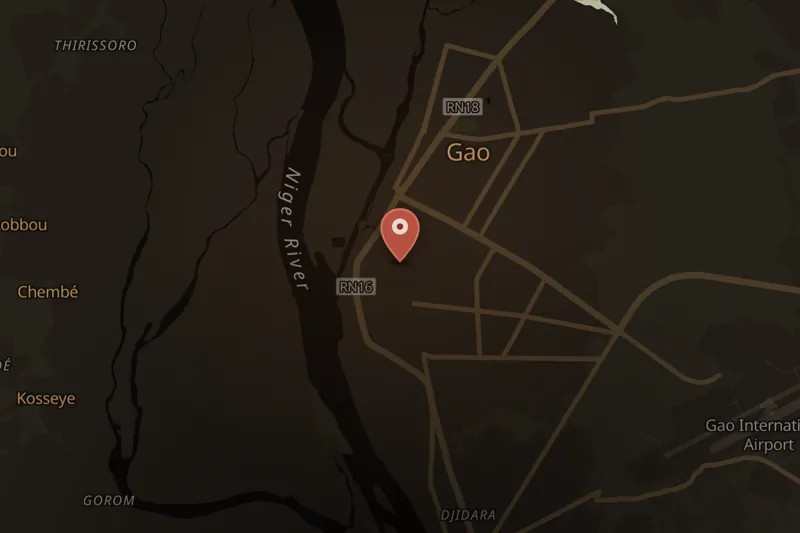
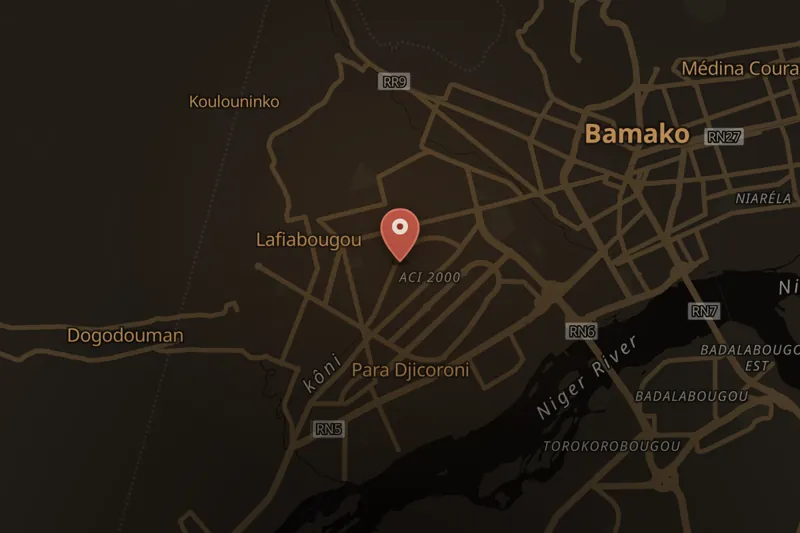
On the morning of 20 November 2015, two gunmen arrived at the Radisson Blu hotel in Bamako, Mali, reportedly in a vehicle bearing diplomatic license plates. A Malian army commander said at least 10 gunmen stormed the hotel shouting "Allahu Akbar," firing on guards and taking hostages, though a later investigation determined only two attackers were involved. Witnesses, including Guinean singer Sekouba Bambino, reported the attackers spoke English rather than Arabic or a local language. Hostages were reportedly asked to recite the Islamic profession of faith (shahada) to secure release.
The hotel, located in a business district near foreign embassies and part of the Carlson Rezidor Hotel Group, held 125 guests and 13 employees when the siege began, according to hotel operators; officials later said roughly 170 people were held hostage in total as the situation unfolded, with many able to escape amid the initial chaos. Hostages included nationals of China, India, the United States, Algeria, Russia, Morocco, Turkey, and France, along with a delegation from the Organisation internationale de la Francophonie and MINUSMA peacekeeping personnel attending a meeting on Mali's peace process.
Malian special forces, backed by UN peacekeepers, U.S. Diplomatic Security Service and Department of Defense personnel, and French forces, moved to end the siege and rescue hostages. Five U.S. personnel were the first responders to enter the building; two were later decorated by the United States, with Army Sergeant First Class Kyle Morgan receiving the Distinguished Service Cross and Marine Gunnery Sergeant Jarad Stout receiving the Silver Star. More than 100 hostages were freed during the operation.
Twenty people were killed: six Malians, six Russians, three Chinese, two Belgians, one American, one Israeli, and one Senegalese. Named victims included Geoffrey Dieudonné, a Belgian counselor with the Brussels-Wallonia regional parliament; three Chinese executives from China Railway Construction Corporation; six Russian employees of Volga-Dnepr Airlines; Anita Ashok Datar, an American public health expert and former Peace Corps volunteer; and Shmuel Benalal, an Israeli education consultant.
Al-Mourabitoun claimed responsibility for the attack, stating it acted jointly with al-Qaeda in the Islamic Maghreb (AQIM); an al-Qaeda member reportedly confirmed the two groups' cooperation. The Macina Liberation Front also claimed responsibility.
Malian President Ibrahim Boubacar Keïta cut short a trip to Chad to coordinate the response, and Mali declared a 10-day state of emergency followed by three days of national mourning. France sent GIGN special forces and forensic officers to assist. The UN Security Council condemned the attack, and several governments issued travel warnings for Mali.
In the investigation, Malian authorities released photographs of the two attackers' bodies three days after the attack but could not identify them, appealing to the public for information. On 27 November 2015, Malian special forces arrested two Malian men in their early 30s on Bamako's outskirts in connection with the attack, linked via a mobile phone recovered at the scene.


 Credit: Pax Ahimsa GethenCC BY-SA 4.0SourceSOLVEDListen