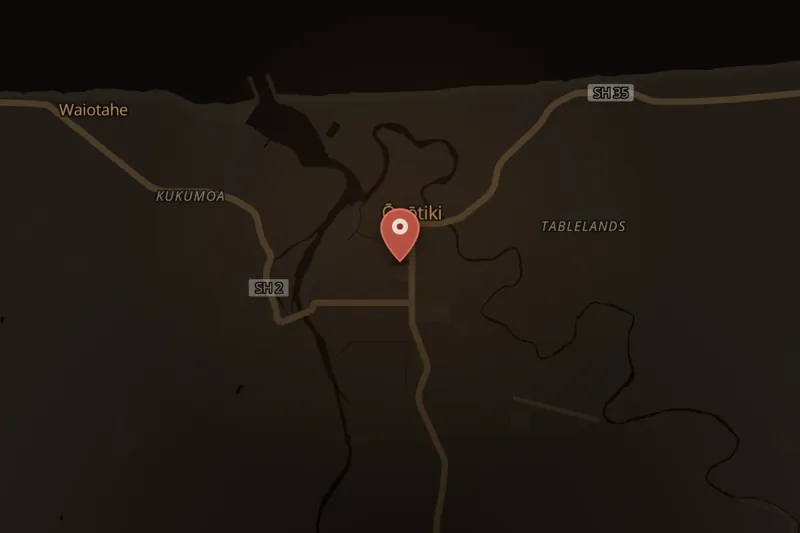
Carl Sylvius Völkner, a German-born Protestant missionary, established a church in Ōpōtiki in the Bay of Plenty at the invitation of Te Whakatōhea chief Mokomoko. Following the Invasion of the Waikato and the Battle of Te Ranga in 1864, many of Völkner's congregation converted to the Pai Mārire faith, and Völkner came under suspicion of secretly reporting to Governor George Grey on Whakatōhea activities. Despite warnings to stay away, Völkner made repeated visits to Auckland and returned to Ōpōtiki on 1 March 1865 (Wikipedia gives 1 March; a related account cites 2 March). He was arrested almost immediately, tried on charges of espionage by Whakatōhea members of the Pai Mārire faith, found guilty after overnight deliberation, and hanged and decapitated at his church grounds. Kereopa Te Rau, a Hauhau adherent, was alleged to have re-entered the church afterward and conducted a service with Völkner's head in the pulpit, and to have plucked out and swallowed the dead missionary's eyes, said to represent Parliament and the Crown.
Governor George Grey responded by declaring martial law in the Bay of Plenty in September 1865 and dispatching roughly 500 government troops, including militia, cavalry, and Ngāti Hau warriors led by Te Keepa Te Rangihiwinui, to Ōpōtiki aboard HMS Eclipse. Landing on 11 September 1865 was difficult; forces opened fire on local inhabitants, forcing them into nearby forest, then looted and burned the pā. Between 16 and 58 people were reported killed in the attack. Troops subsequently conducted a scorched-earth campaign against the wider countryside, destroying food supplies, with the stated aim of forcing surrender of those responsible for Völkner's death.
Mokomoko, who had not been involved in planning Völkner's death, surrendered on the understanding that his tribe would not be punished. He and four other men were instead arrested, tried in Auckland, and convicted largely on the basis that the rope used to hang Völkner was treated as sufficient evidence. Mokomoko and the others were executed at Mount Eden Prison on 17 May 1866. Kereopa Te Rau, considered the man most responsible, evaded capture for years by retreating to Tūhoe lands in the Urewera mountains; he was eventually surrendered to government forces in the early 1870s, tried with some Crown witnesses granted immunity and no funded defence witnesses, and hanged for Völkner's murder on 5 January 1872 after a jury deliberation of about fifteen minutes.
Approximately 85,000 acres of land in the eastern Bay of Plenty were confiscated from local iwi under the New Zealand Settlements Act 1863. In 1993, Justice Minister Doug Graham apologised to Te Whakatōhea and issued an official pardon for Mokomoko. In 1996 the government signed a Deed of Settlement acknowledging the wrongful invasion and confiscation of Te Whakatōhea lands. A 1998 compensation offer of NZ$40 million was not accepted. Kereopa Te Rau was posthumously pardoned in November 2014 as part of the Ngāti Rangiwewehi Treaty of Waitangi settlement.


 SOLVEDListen