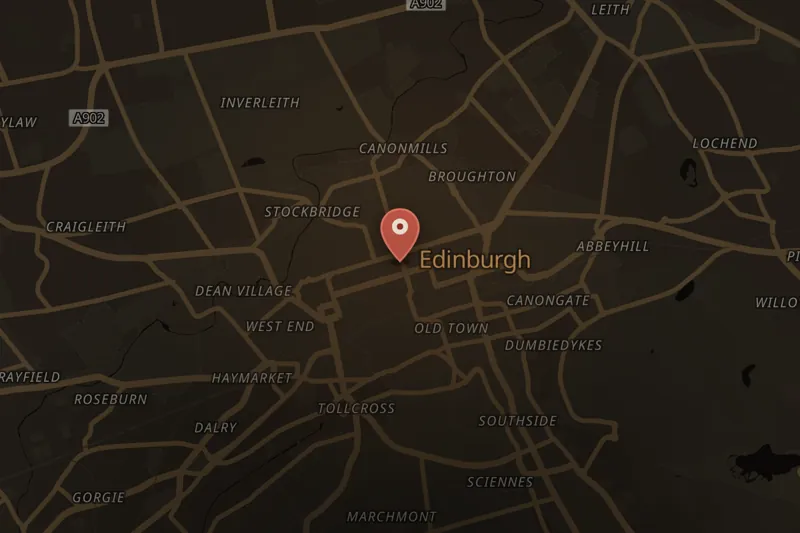
On the night of 15 October 1977, Christine Eadie and Helen Scott, both seventeen, were seen leaving The World's End pub on the Royal Mile in Edinburgh's Old Town at closing time. The following day, Eadie's naked body was found in the dunes at Gosford Bay, East Lothian, by a couple walking there. Scott's body was found unclothed roughly six miles away, in a corn-stubble field. Both girls had been beaten, gagged, tied up, raped and strangled; no attempt had been made to conceal either body.
Lothian and Borders Police mounted a large investigation in late 1977, compiling a list of over 500 suspects and taking more than 13,000 statements, but were unable to identify a culprit, and the investigation was scaled down by May 1978. Witnesses reported seeing the girls talking to two men near a public telephone in the pub; those men were never traced, and differing knot types used to bind the victims fuelled speculation that more than one attacker was involved.
In 1997 a cold case review used advances in DNA profiling to isolate a male DNA profile found on both victims, though comparison against the original suspect pool produced no match. A 2003 Crimewatch reconstruction generated new tips, including a report of a suspicious van near Gosford Bay on the night of the murders. Forensic work eventually linked the DNA to Angus Sinclair, who was detained in November 2004 and charged in March 2005.
Sinclair stood trial in 2007 at the High Court of Justiciary in Edinburgh. The Crown's case was wholly circumstantial, resting on forensic evidence including matching DNA profiles from both victims and analysis suggesting involvement of Sinclair's late brother-in-law, Gordon Hamilton, whom Sinclair named in a special defence of incrimination. On 10 September 2007, the trial judge upheld a defence submission of no case to answer, acquitting Sinclair before the case reached the jury. The outcome caused significant public and political controversy, including an address to the Scottish Parliament by the Lord Advocate and public criticism from the Lord Justice General, and prompted a Scottish Law Commission review leading to reforms including the Double Jeopardy (Scotland) Act 2011.
Following that legislative change, prosecutors were granted permission in April 2014 to retry Sinclair. A second trial began in October 2014 at the High Court of Justiciary sitting in Livingston. On 14 November 2014, Sinclair was convicted of both murders and sentenced to life imprisonment with a minimum term of 37 years, described as the longest such sentence imposed by a Scottish court. He died at HM Prison Glenochil on 11 March 2019, aged 73.
Sinclair had a prior history of violent offending, including a 1961 conviction for the culpable homicide of eight-year-old Catherine Reehill, a 1982 conviction on multiple charges of rape and indecent assault, and a 2001 conviction for the 1978 murder of 17-year-old Mary Gallacher in Glasgow.


 Credit: Unknown author; searches have been unable to identify the specific artist. These…Public domainSourceSOLVEDListen