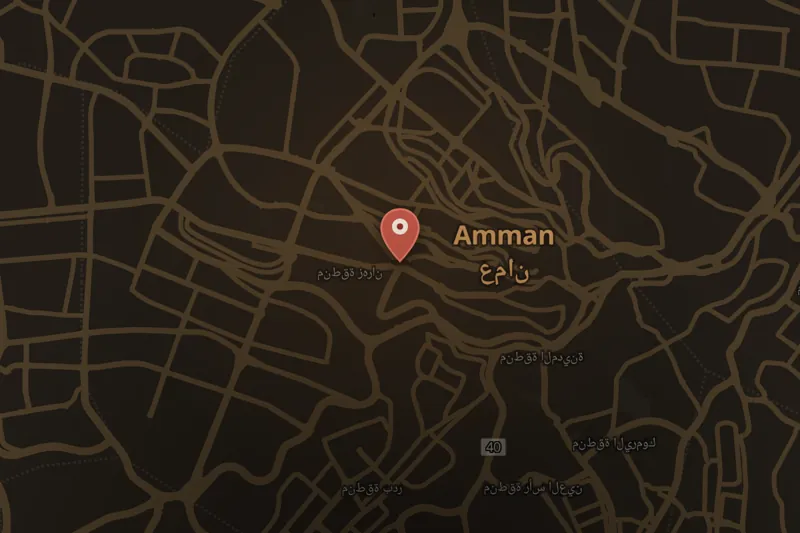
On 10 June 1998, between approximately 12:00 a.m. and 2:00 a.m., twelve people were killed in a mass shooting at the Qashash family home on the outskirts of southern Amman, Jordan. Eleven of the victims were members of the Qashash family — Saeed al-Qashash's parents, six siblings, a brother-in-law, a nephew, and a niece — along with a classmate, Atta al-Shalan. Five of the victims were children, and all were shot in the back of the head. Investigators initially believed each victim had been lured into the basement individually and killed shortly after arriving, though Saeed al-Qashash later stated he first killed his mother, Thuria, while she was working in the kitchen.
After the killings, Qashash telephoned his father's workplace to report that his father, a school bus driver, would be unable to work due to illness. He then piled up the bodies, covered them with blankets and a carpet, and used his brother-in-law's car to buy bricks and cement, which he used to wall the bodies into the basement. Later that day, he informed another relative of the "discovery" of the crime, falsely claiming he had spent the night studying at a friend's house and found the scene upon returning home. He and the relative then contacted police. Because he was the sole surviving member of his household, Qashash became a suspect and was arrested two days later, confessing to the murders while in police custody.
According to reporting by the Associated Press, Qashash had failed his final year of high school in 1997 and had recently completed the first of two required Tawjihi repeat examinations. His father had repeatedly threatened to expel him from the household if he failed again, and other family members, along with his friend Atta al-Shalan, had reportedly harassed him about his academic failures. Qashash had stolen his father's 7 mm revolver and purchased 25 bullets in the week before the attack.
On 30 November 1998, following a one-day trial, Qashash was convicted on twelve counts of premeditated murder by Judge Mohammed Ajamieh. He asked the judge to spare his life but was sentenced to death; he reportedly showed no reaction to the sentence. Amnesty International opposed the death sentence and urged then–Crown Prince Hassan bin Talal to commute it. Qashash was executed by hanging on 6 June 1999 at Swaqa Prison, roughly 60 miles south of Amman, and was formally declared dead early the following morning. In his final statement, he asked for forgiveness and apologized for the killings. Relatives declined to accept his body for burial, and government authorities handled the arrangements instead.
The case caused widespread shock in Jordan, a country with nationally low crime rates, and is described as the deadliest familicide in modern Jordanian history.

 Credit: FBIPublic domainSourceSOLVEDListen