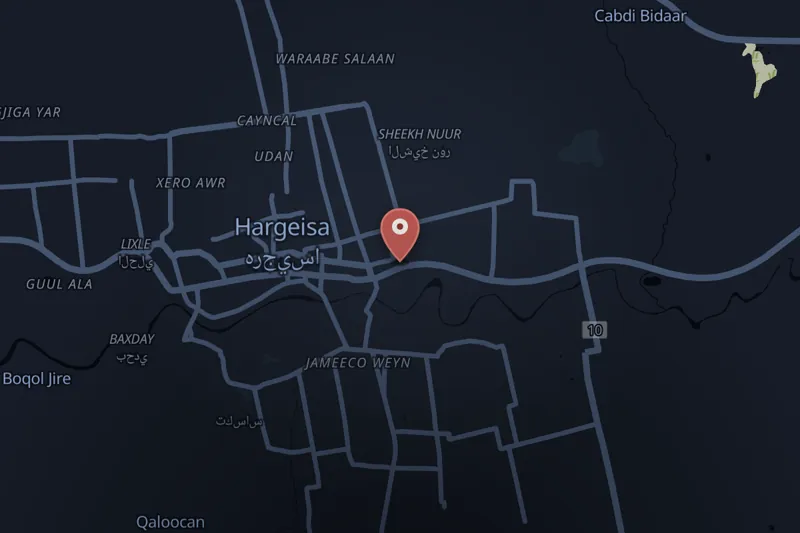
On October 29, 2008, six suicide bombers carried out coordinated car bombings in two Somali cities: Hargeisa, the capital of the self-declared republic of Somaliland, and Bosaso, a port city in the semi-autonomous Puntland region of northeastern Somalia. The attacks killed at least 30 people. In Hargeisa, targets included the presidential palace, the Ethiopian consulate, and the offices of the United Nations Development Programme (UNDP). In Bosaso, bombers struck the offices of the Puntland Intelligence Service.
The deadliest single strike was at Ethiopia's consulate in Hargeisa, where 20 people were killed. Synchronized blasts at the office of Somaliland's president and a UN building in Hargeisa killed at least five more people, including two UN staff members — a driver and a security adviser. Six additional UN staff were injured when the blast destroyed the roofs of the UN compound. Mark Bowden, the UN humanitarian coordinator for Somalia, noted that Hargeisa had previously been considered relatively stable compared with other parts of Somalia, which UN personnel found dangerous. In Bosaso, medical staff reported on October 30 that two more soldiers wounded in the intelligence headquarters blast had died overnight, bringing the toll from that strike to at least five.
In the aftermath, Puntland authorities arrested a prominent local sheik in connection with this attack and a wider recent wave of bombings. A relative, Abdishakur Mire, said soldiers had attacked their home, opened fire, and injured and detained his uncle. Authorities did not release further details of the case against him, though Somalia’s Interior Minister, Abdillahi Ismail, said the attacks had been planned from Mogadishu. He was released on November 10, 2008, without further reported charges detailed in this account.
Separately, authorities in Minneapolis, Minnesota, investigated whether Shirwa Ahmed, a Somali immigrant and Minneapolis resident, was one of the suicide bombers involved in the attack.
The presidents of both Somaliland and Puntland condemned the bombings. Somaliland's president, Dahir Rayale Kahin, characterized the attacks as a strike against Somaliland's "nationhood" and described them as unusual in a territory that had otherwise remained comparatively peaceful. He pledged that efforts would be made to identify those responsible.
No group formally claimed responsibility for the bombings. Suspicion broadly fell on Islamist insurgents fighting the Somali transitional government and its Ethiopian military allies, with the group Al-Shabaab widely believed to be responsible. Al-Shabaab posted an online video of a suicide bomber but did not explicitly link it to these attacks. The United States attributed the bombings to al-Qaeda, which it said operated through Al-Shabaab. The attacks drew international attention and overshadowed a summit in Kenya addressing Somalia's prolonged conflict.