
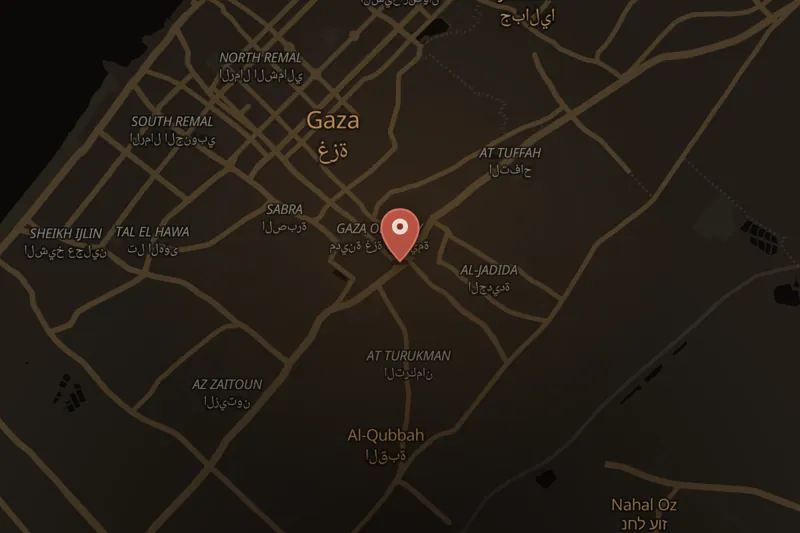

Sabra neighborhood, Gaza City · 2000s
Killing of Ahmed Yassin
On 22 March 2004, Hamas founder Ahmed Yassin, 67, was killed in an Israeli military airstrike as he left dawn prayers in Gaza City, along with several companions and bystanders.
Solved case · 2004
The short answer
On 17 April 2004, Hamas leader Abdel Aziz al-Rantisi, 56, was killed in Gaza City along with two bodyguards when Israeli warplanes fired missiles at his car, prompting widespread international condemnation.
No one's coverage is attached to this file yet.
Know great coverage of this case?
A documentary, a podcast episode, a careful long-form video. Suggest it and an editor will review it before it appears here.
Suggest coverage for Assassination of Abdel Aziz al-RantisiOn the evening of 17 April 2004, Abdel Aziz al-Rantisi, the leader of Hamas in the Gaza Strip, was killed at age 56 when Israeli warplanes fired missiles at the vehicle in which he was traveling. Two of his bodyguards were also killed in the strike. The operation was considered part of a broader campaign to eliminate leaders of groups involved in the uprising against Israel. The killing occurred less than a month after the assassination of Hamas founder Ahmed Yassin.
Al-Rantisi was one of the founders of Hamas, established in December 1987. He had a long history of arrest and detention: he was arrested on 4 March 1988 and held until 4 September 1990, then deported on 17 December 1992 to southern Lebanon along with 425 other Hamas and Islamic Jihad members. After being allowed to return, he was imprisoned again until 1997, and was separately detained by Palestinian Authority security forces for 15 months.
Al-Rantisi had previously survived an assassination attempt on 10 June 2003, when an Israeli Apache helicopter targeted his vehicle with a missile. That earlier strike killed three Palestinians, including a woman and a girl, and left Al-Rantisi wounded with shrapnel injuries; his son was also wounded in the attack. He reportedly vowed to continue "resistance efforts" while still recovering from surgery.
In the 17 April 2004 attack, Al-Rantisi was still alive when taken to hospital, where he died a short time later. Hamas spokesman Ismail Haniyeh vowed to avenge the death.
The assassination drew condemnation from multiple governments and officials, including the European Union, Bahrain, Egypt, Iran, Italy, the Palestinian Authority, Yemen, and the United Kingdom, many of whom characterized the targeted killing as unlawful or counterproductive to the peace process. Israel's UN representative defended the operation, framing Al-Rantisi as an architect of violence against Israeli civilians, and the Israeli Prime Minister praised those involved in the operation. The United States declined to condemn the killing, with a White House spokesman emphasizing Israel's right to defend itself while expressing concern for regional peace and stability.
Al-Rantisi's funeral took place the following day and drew large, angry crowds, including fighters from various Palestinian national and Islamic organizations. Hamas named a new leader without publicly disclosing the individual's identity for security reasons. Days later, on 20 April 2004, Israeli forces shot dead four Palestinians, and then-Prime Minister Ariel Sharon warned of further actions against Hamas leadership.
Analysis attributed to Khaled Hroub describes a resulting paradox for Hamas: a surge in popularity for the movement alongside significant organizational weakening following the killings of both Rantisi and Yassin.
Hamas founded; Abdel Aziz al-Rantisi among its founders.
Al-Rantisi arrested.
Al-Rantisi released from detention.
Al-Rantisi deported to southern Lebanon along with 425 other Hamas and Islamic Jihad activists.
Al-Rantisi survives an Israeli Apache helicopter missile attack on his vehicle; three Palestinians killed, Al-Rantisi and his son wounded.
Hamas founder Ahmed Yassin is killed, less than a month before Al-Rantisi's assassination.
Israeli warplanes fire missiles at Al-Rantisi's car in Gaza City, killing him and two bodyguards.
Al-Rantisi's funeral takes place, drawing large crowds; Iranian Foreign Ministry condemns the killing.
Israel Defense Forces shoot dead four Palestinians; Israeli Prime Minister Ariel Sharon warns of further attacks on Hamas leaders.
Victims first. Every legal label is set from public records and court outcomes, not from the prose.
Leader of Hamas in the Gaza Strip, killed in an Israeli airstrike on his vehicle on 17 April 2004.[3]
Coverage is not a source: every fact in this file rests on the records below.
Are you family of someone named in this file? Corrections and removal requests from victims’ families are prioritized.
Sabra neighborhood, Gaza City · 2000s
On 22 March 2004, Hamas founder Ahmed Yassin, 67, was killed in an Israeli military airstrike as he left dawn prayers in Gaza City, along with several companions and bystanders.
Gaza Strip and southern Israel · 2020s
On 7 October 2023, Hamas-led militants abducted 251 people from Israel into the Gaza Strip during the attacks that began the Gaza war, including children, women, and elderly civilians, along with soldiers. Hostages were held for extended periods under harsh conditions, with releases occurring through negotiated ceasefires, rescue operations, and body recoveries over more than two years, concluding with the return of the last hostage's remains in January 2026.
Gaza Strip · 2010s
During the 2014 Gaza War, Hamas captured Israeli soldiers Oron Shaul and Hadar Goldin and retained their remains for years; Shaul's body was recovered by Israeli forces in January 2025, and Goldin's body was returned by Hamas in November 2025.
 Credit: Oliver MarkCC BY-SA 4.0SourceSOLVEDListen
Liaquat National Bagh, Rawalpindi, Pakistan · 2007
Former Pakistani Prime Minister Benazir Bhutto was killed on 27 December 2007 in Rawalpindi following a shooting and suicide bombing after a political rally, an attack that also killed 23 other people. A UN inquiry found her security had been fatally insufficient and the crime scene mishandled; two police officers were later convicted, five Taliban-linked suspects were acquitted, and Pervez Musharraf was indicted but declared a fugitive before being separately sentenced in absentia on unrelated treason charges.
Apartment block, central Moscow, Russia · 2006
Russian journalist and human rights activist Anna Politkovskaya, a prominent critic of the Second Chechen War and of Vladimir Putin, was shot dead in her Moscow apartment building elevator on 7 October 2006. After a lengthy and repeatedly stalled investigation, six people were eventually convicted of crimes related to her murder, though the identity of whoever ordered the killing was never conclusively established in court.
 Credit: MiradaCC BY-SA 3.0SourceSOLVEDListen
Şişli, Istanbul, Turkey · 2007
Turkish-Armenian journalist Hrant Dink, editor of the newspaper Agos, was shot dead outside his office in Istanbul on 19 January 2007. Ogün Samast was convicted of the killing; Yasin Hayal and Erhan Tuncel were convicted for their roles in inciting and orchestrating the assassination, with dozens of others later tried over the broader plot.


