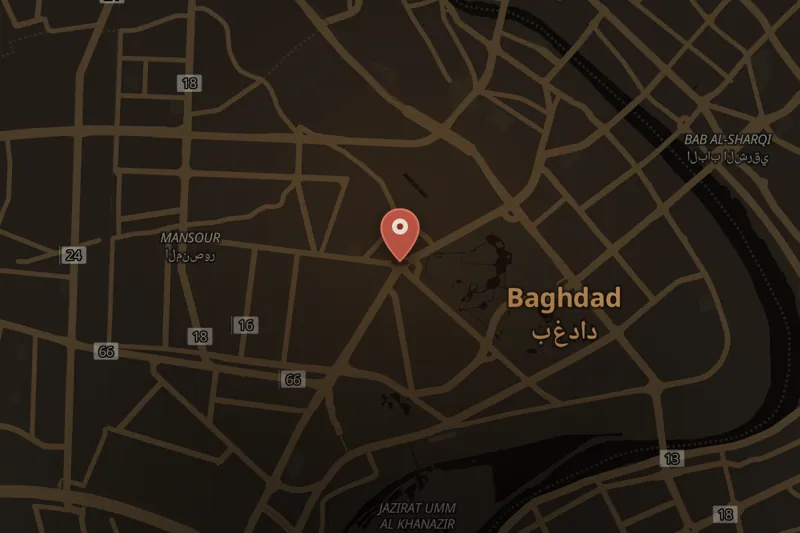
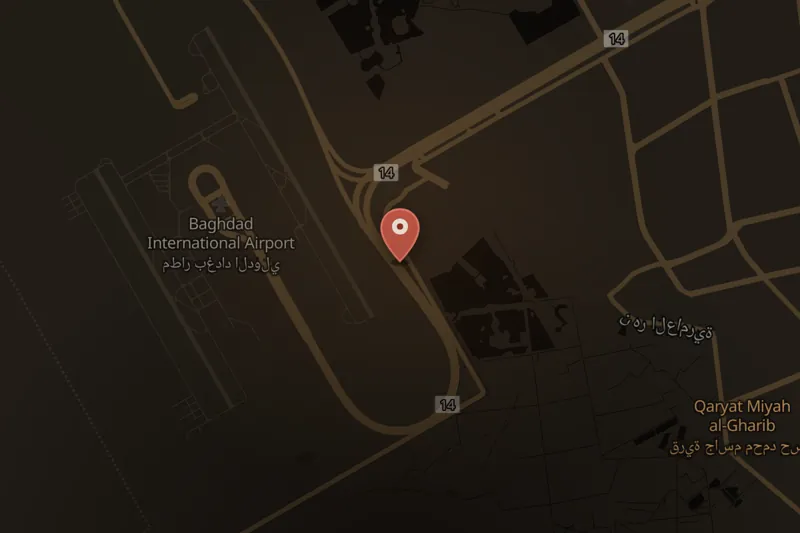
On 3 January 2020, at 12:47 a.m. local time, a U.S. Air Force MQ-9 Reaper drone launched missiles at a two-vehicle convoy departing Baghdad International Airport, killing Iranian Major General Qasem Soleimani, commander of the Islamic Revolutionary Guard Corps' (IRGC) Quds Force, and nine others. Among the dead was Abu Mahdi al-Muhandis, deputy chairman of Iraq's Popular Mobilization Forces (PMF) and commander of the Iran-backed Kata'ib Hezbollah militia. Four other IRGC officers and four other PMF members were also killed. The strike was ordered by U.S. President Donald Trump and was announced by the U.S. Department of Defense as being carried out "at the direction of the president" to deter future attacks.
The strike occurred amid the 2019–2022 Persian Gulf crisis, which followed the U.S. withdrawal from the 2015 Iran nuclear deal in 2018 and the reimposition of sanctions. In the immediate lead-up, a 27 December 2019 rocket attack on the K-1 Air Base in Iraq killed an American contractor, prompting U.S. airstrikes on Kata'ib Hezbollah facilities that killed 25 militia members. Days later, Shia militiamen and supporters stormed the perimeter of the U.S. embassy compound in Baghdad's Green Zone, setting fires and leaving anti-American graffiti. According to reporting cited in the case record, Trump had initially rejected targeting Soleimani in late December 2019 but reportedly finalized the decision after being angered by television coverage of the embassy attack.
U.S. officials, including Secretary of State Mike Pompeo, initially cited the need to stop an "imminent attack" as justification, later describing the action's legal basis as a response to "an escalating series of attacks" intended to protect U.S. personnel and deter further Iranian-backed aggression. Some experts, including the United Nations special rapporteur on extrajudicial, summary or arbitrary executions, characterized the strike as a likely violation of international law. Iran called it an act of "state terrorism," and the Iraqi government said it violated Iraqi sovereignty and bilateral security agreements. On 5 January 2020, the Iraqi parliament passed a non-binding resolution calling for the expulsion of foreign troops.
The killing sharply escalated U.S.-Iran tensions. Iranian leaders vowed "shattering revenge." On 8 January 2020, Iran launched ballistic missiles at U.S. forces at Al Asad Airbase and near Erbil in Iraq; several dozen U.S. servicemen were later confirmed injured, though no fatalities were initially reported. On the same day, the IRGC shot down Ukraine International Airlines Flight 752 near Tehran, killing all 176 people aboard, reportedly after mistaking it for a hostile target. No further direct military exchanges between the U.S. and Iran followed. Soleimani's remains were returned to Iran on 5 January 2020 for mourning processions in multiple cities; during burial proceedings in Kerman on 7 January 2020, a stampede killed at least 56 people and injured 213, postponing the burial.


 Credit: U.S. Government copyright Photographed by an unidentified member of the United States…Public domainSourceUNSOLVEDListen