

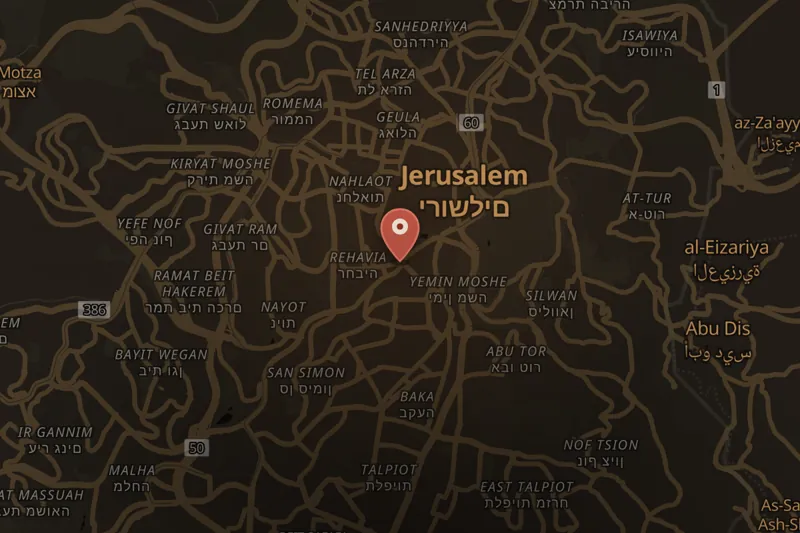

Gaza Street, Jerusalem · 2000s
Gaza Street bus bombing
On January 29, 2004, a Palestinian suicide bomber detonated an explosive belt aboard Egged bus #19 on Gaza Street in Jerusalem, killing 11 passengers and wounding more than 50 others.
The short answer
On March 9, 2002, a Palestinian suicide bomber detonated an explosive device inside the Café Moment coffee shop in the Rehavia neighborhood of Jerusalem, killing 11 Israeli civilians and wounding 65 others during the Second Intifada.
No one's coverage is attached to this file yet.
Know great coverage of this case?
A documentary, a podcast episode, a careful long-form video. Suggest it and an editor will review it before it appears here.
Suggest coverage for Café Moment bombingOn the evening of March 9, 2002, shortly before 22:30, a Palestinian suicide bomber entered "Café Moment," a popular coffee shop in Jerusalem's Rehavia neighborhood, located at the corner of Gaza Street and Ben-Maimon Street, roughly 100 meters from the Israeli Prime Minister's residence. Upon entering, the bomber detonated an explosive device concealed under his clothing. The blast destroyed the café and killed 11 Israeli civilians instantly, while injuring 65 others, 10 of them severely. The attack occurred during the Second Intifada, at a location described as one of Jerusalem's most popular recreational gathering spots at the time.
Hamas claimed responsibility for the bombing.
On August 17, 2002, Israeli security forces arrested members of a Hamas cell alleged to have carried out the attack. The individuals were residents of East Jerusalem who held Israeli-issued blue identity cards as permanent residents, which allowed them to travel and work within Israel without arousing suspicion. Israeli security forces stated that this group, referred to in media coverage as the "Silwan cell," was responsible for a series of attacks against Israeli civilians in addition to the Café Moment bombing, with the cell's attacks collectively killing 35 Israeli civilians and injuring 200 others. According to Israeli security forces, the cell operated under instructions from Hamas headquarters in Ramallah directing members to locate crowded public spaces for mass-casualty attacks.
In October 2011, members of the Silwan cell were released from Israeli prison as part of the Gilad Shalit prisoner exchange, a deal in which Israel released Palestinian prisoners in exchange for the return of an Israeli soldier held by Hamas.
A civil lawsuit was subsequently filed against the Arab Bank alleging that the institution provided financing connected to the attack.
The bombing occurred during March 2002, which was the month with the highest fatality rate for Israelis during the Second Intifada, with 111 Israeli soldiers and civilians killed that month across more than a dozen militant attacks nationwide. These attacks culminated later that month, on March 27, 2002, in the Passover massacre, which the source states led the Israeli government to launch a major military campaign targeting Palestinian militant infrastructure in the West Bank.
A Palestinian suicide bomber detonates an explosive device inside the Café Moment coffee shop in the Rehavia neighborhood of Jerusalem, killing 11 Israeli civilians and injuring 65 others.
The Passover massacre occurs, marking the peak of a wave of attacks during the deadliest month of the Second Intifada for Israeli fatalities.
Israeli security forces arrest members of the 'Silwan cell,' a Hamas cell alleged to have carried out the Café Moment bombing and other attacks.
Members of the Silwan cell are released from prison as part of the Gilad Shalit prisoner exchange.
Victims first. Every legal label is set from public records and court outcomes, not from the prose.
No public people records are attached to this file yet.
Coverage is not a source: every fact in this file rests on the records below.
Are you family of someone named in this file? Corrections and removal requests from victims’ families are prioritized.
Gaza Street, Jerusalem · 2000s
On January 29, 2004, a Palestinian suicide bomber detonated an explosive belt aboard Egged bus #19 on Gaza Street in Jerusalem, killing 11 passengers and wounding more than 50 others.
 Credit: Bachrach44CC BY-SA 3.0SourceSOLVEDListen
Liberty Bell Park, Emek Refaim, German Colony, Jerusalem · 2000s
On February 22, 2004, a suicide bomber detonated an explosive device aboard Egged bus No. 14A near Liberty Bell Park in Jerusalem, killing eight passengers and injuring more than 60, including schoolchildren.
 Credit: Utilisateur:DjampaCC BY-SA 4.0SourceSOLVEDListen
Zion Square, Jerusalem · 1970s
On July 4, 1975, a booby-trapped refrigerator packed with explosives detonated inside an appliance store at Zion Square in Jerusalem, killing 15 civilians and wounding 77 others.
Shanksville, Somerset County, Pennsylvania · 2001
On September 11, 2001, four hijackers affiliated with al-Qaeda took control of United Airlines Flight 93 en route from Newark to San Francisco, intending to crash it into a federal government building in Washington, D.C. After learning by phone of the day's other attacks, passengers and crew fought back, and the aircraft crashed into a field near Shanksville, Pennsylvania, killing all 44 people aboard.
 Credit: nrkbetaCC BY-SA 2.0SourceSOLVEDListen
Oslo and Utøya, Norway · 2011
On 22 July 2011, Anders Behring Breivik detonated a car bomb in Oslo's government quarter, killing 8, then carried out a mass shooting at a Workers' Youth League (AUF) summer camp on the island of Utøya, killing 69. He was convicted in 2012 and sentenced to 21 years of preventive detention, Norway's maximum sentence.
 Credit: Oliver MarkCC BY-SA 4.0SourceSOLVEDListen
Liaquat National Bagh, Rawalpindi, Pakistan · 2007
Former Pakistani Prime Minister Benazir Bhutto was killed on 27 December 2007 in Rawalpindi following a shooting and suicide bombing after a political rally, an attack that also killed 23 other people. A UN inquiry found her security had been fatally insufficient and the crime scene mishandled; two police officers were later convicted, five Taliban-linked suspects were acquitted, and Pervez Musharraf was indicted but declared a fugitive before being separately sentenced in absentia on unrelated treason charges.
