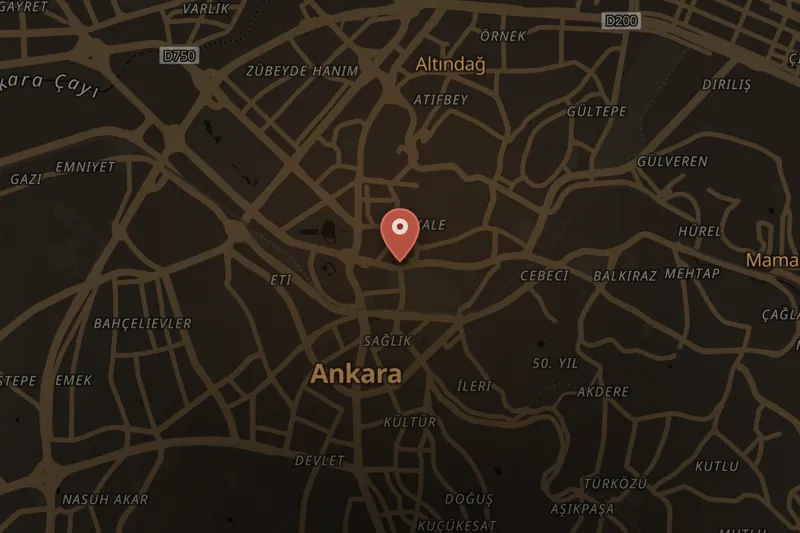
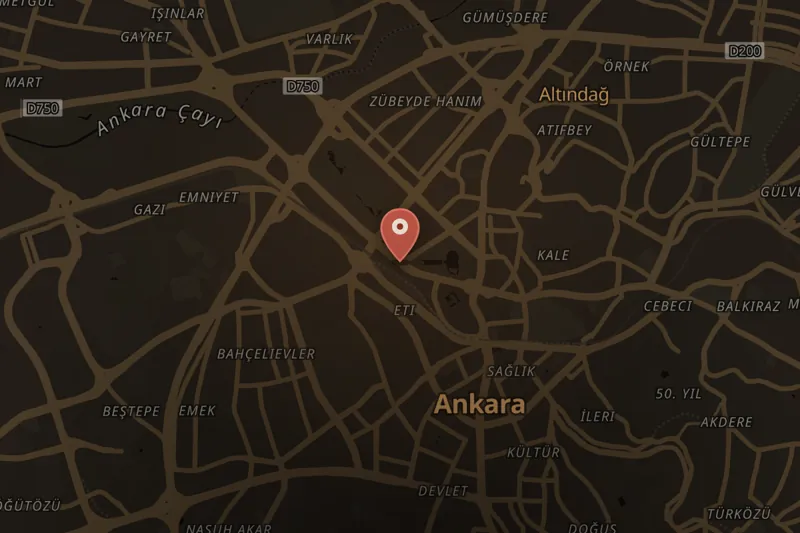
On the evening of 17 February 2016, a car bomb exploded in Ankara, Turkey, as army buses carrying military personnel were stopped at traffic lights at an intersection with İsmet İnönü Boulevard, near the Kızılay neighborhood. The area is home to several government ministries, army headquarters, and the Turkish Parliament. According to Turkish authorities, the attack targeted a convoy of vehicles carrying both civilian and military personnel employed at the military headquarters during evening rush hour.
The blast killed at least 30 people and injured 60. The dead included the perpetrator, 14 military personnel, 14 civilian employees of the military, and one additional civilian who died from wounds in hospital on 23 February 2016. Turkish news channels showed footage of a large fire engulfing military vehicles after the explosion, which was reportedly heard several kilometres away. Censorship monitoring organization Turkey Blocks reported nationwide internet restrictions beginning approximately one hour after the blast, pursuant to an administrative order.
The Kurdistan Freedom Hawks (TAK), an organization that split from the Kurdistan Workers' Party (PKK), took responsibility for the attack, stating it targeted security forces. Turkish government officials initially identified the bomber as a Syrian Kurd named Salih Necar, said to have been trained by the YPG, PKK, and Syrian government. TAK instead named the bomber as Abdülbaki Sönmez and released a photograph that was later found to be an edited image of an unrelated Turkish blogger. Subsequent DNA analysis confirmed the perpetrator was Turkish-born Abdulbaki Sönmez, a Turkish citizen — not the Syrian-born Salih Necar initially presented to the public by then-Prime Minister Ahmet Davutoğlu. Syrian Kurdish authorities stated that no person named Salih Necar from Hasakah existed. Following the DNA findings, Deputy Prime Minister Numan Kurtulmuş stated that the bomber's identity discrepancy did not change the Turkish government's assessment that the individual had entered Turkey from the PYD region. Turkish officials maintained that the attack was planned by the YPG, PKK, PYD, and the Syrian government, and that TAK was being used to "exonerate" the YPG.
The bombing occurred against a backdrop of heightened tension: in October 2015, a bombing at a peace rally in Ankara had killed over 100 people amid a renewed PKK insurgency, and on 13 February 2016 Turkish shelling of Kurdish positions in Syria prompted a closed-door UN Security Council briefing at Russia's request, with members expressing concern over Turkey's actions. Hours before the February bombing, President Recep Tayyip Erdoğan had labeled the PYD a "terrorist organisation."
Domestically, Erdoğan and Davutoğlu condemned the attack and vowed retaliation; Davutoğlu cancelled planned trips abroad. The opposition HDP condemned the bombing but disputed a unilaterally drafted parliamentary declaration, which was ultimately issued by the AKP, CHP, and MHP. Internationally, an EU summit in Brussels was cancelled, and leaders from Germany, the United Kingdom, the United States, Finland, Kosovo, Ukraine, and Poland, as well as NATO and EU officials, issued statements condemning the attack.


 Credit: Modern primatCC BY-SA 4.0SourceSOLVEDListen