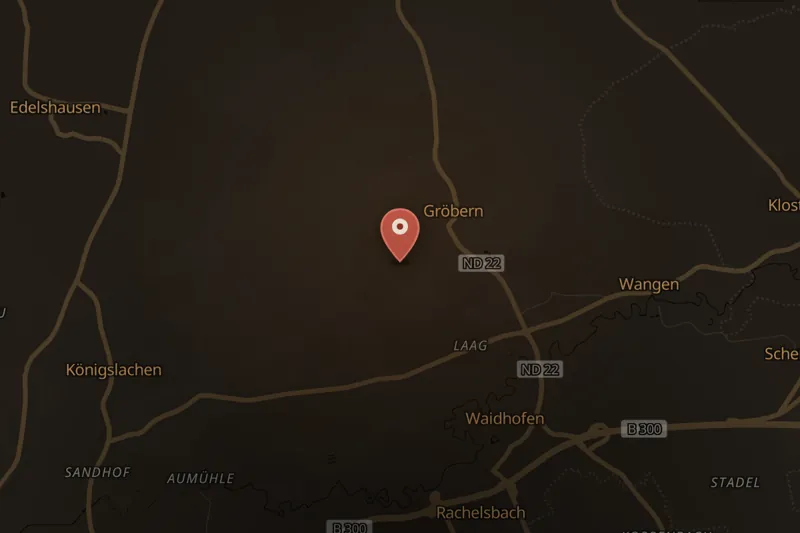
On the evening of 31 March 1922, six inhabitants of the small Bavarian farmstead known as Hinterkaifeck, located roughly 70 kilometres north of Munich, were killed by an unidentified perpetrator. The victims were farm owner Andreas Gruber (63), his wife Cäzilia (72), their widowed daughter Viktoria Gabriel (35), her children Cäzilia (7) and Josef (2), and the family's newly hired maid, Maria Baumgartner (44), who had arrived at the farm only the day before. All six were killed with a mattock, a farm tool later recovered hidden in the barn's loft. Evidence indicated that Viktoria, her daughter, and her parents were lured into the barn and killed there first, followed by the murders of Josef and Maria inside the farmhouse.
In the months preceding the killings, the household reported unexplained events, including noises in the attic that had prompted a previous maid to quit, an unclaimed newspaper found on the property, and footprints in the snow leading to a farm building with a broken lock. These reports were not made to police at the time.
The bodies were not discovered until 4 April 1922, four days after the killings, when neighbour Lorenz Schlittenbauer and others entered the farm after repeated failed visits by tradesmen and a mechanic, and after the family's absence from school and church had been noticed. Investigators determined that the perpetrator had remained on the property for several days afterward, feeding the livestock, using the fireplace, and consuming food from the house.
An investigation led by Munich inspector Georg Reingruber was hampered by contamination of the crime scene, as numerous onlookers had already moved bodies and evidence and even prepared meals in the farmhouse kitchen. An initial theory of robbery as a motive was dropped after money was found undisturbed in the house. Numerous individuals were investigated as suspects over the following decades, including Viktoria's husband Karl Gabriel (reported killed in World War I but whose body was never recovered), neighbour Lorenz Schlittenbauer (who had a prior relationship with Viktoria and behaved suspiciously at the scene), members of the Freikorps Oberland paramilitary group, and several local men named by a former maid, Kreszenz Rieger, and other witnesses. None of these individuals were ever convicted, and the case was formally closed by authorities in 1955, with final interrogations occurring as late as 1986.
The case has since become one of the most widely discussed unsolved crimes in German history. It has inspired documentaries, plays, radio broadcasts, and a best-selling fictionalized novel, and was reexamined in 2007 by police academy students using modern investigative methods, though the perpetrator's identity was never conclusively established.

Key facts
- Victims
- Cäzilia Gabriel, Viktoria Gabriel, Josef Gruber, Cäzilia Gruber, Maria Baumgartner, Andreas Gruber
- Date
- 1920s
- Location
- Hinterkaifeck farmstead site
- Case status
- unsolved
Case timeline
1858-11-09
Andreas Gruber born in Grainstetten, Bavaria.
1877
Ownership of Hinterkaifeck farm given to Cäzilia Sanhüter (later Gruber) as part of a divorce settlement.
1886
Andreas Gruber marries Cäzilia Sanhüter.
1914-03-11
Ownership of Hinterkaifeck transferred to Viktoria and her husband Karl Gabriel.
1914-12-12
Karl Gabriel reported killed at the Battle of Arras.
1915
Andreas Gruber and daughter Viktoria convicted of incest by Neuburg district court.
1919
Andreas Gruber again reported to authorities over continued abuse of Viktoria; case dropped after trial.
1921-09
Former maid Kreszenz Rieger leaves her position at Hinterkaifeck, reportedly citing unexplained noises.
1922-03
Andreas Gruber reports finding an unexplained newspaper and, days later, footprints in the snow leading to the farm.
1922-03-31
New maid Maria Baumgartner arrives at Hinterkaifeck; that evening, six residents are murdered with a mattock.
1922-04-01
Coffee sellers visit the farm and find no one home, but do not raise an alarm.
1922-04-04
Neighbour Lorenz Schlittenbauer and others discover the bodies at Hinterkaifeck.
1922-04-05
Court physician Johann Baptist Aumüller performs autopsies at the scene.
1923
Hinterkaifeck farmstead demolished; a bloodied mattock and a penknife recovered during demolition.
1951
Prosecutor Andreas Popp questions suspects Adolf and Anton Gump about the murders.
1954
Case against Anton Gump discontinued for lack of proof.
1955
Investigation officially closed.
1986
Final interrogations in the case take place before the retirement of Detective Chief Superintendent Konrad Müller-Thumann.
2007
Police academy students in Fürstenfeldbruck re-examine the case using modern investigative techniques.
Best coverage
No approved coverage links are attached yet.
People
Cäzilia Gabriel
VICTIMSeven-year-old daughter of Viktoria Gabriel, killed at Hinterkaifeck
Viktoria Gabriel
VICTIMDaughter of Andreas and Cäzilia Gruber, killed at Hinterkaifeck
Josef Gruber
VICTIMTwo-year-old son of Viktoria Gabriel, killed at Hinterkaifeck
Cäzilia Gruber
VICTIMWife of Andreas Gruber, killed at Hinterkaifeck
Maria Baumgartner
VICTIMNewly hired maid, killed at Hinterkaifeck one day after starting work
Andreas Gruber
VICTIMFarm owner, killed at Hinterkaifeck on 31 March 1922
Roles reflect public records and court outcomes at the time of writing — supporting citations are on file under Sources.
Archival records

archival location
Hinterkaifeck-Hof (cropped)
Credit: Andreas Biegleder. According to a letter from the City Archive of Munich from October 2, 2013, number 3053/3231.0, Andreas Biegleder was born 1880-10-25 in Ergoldsbach and died 1954-05-14 in Munich, last address from 1953-04-17 Munich, Weltenburger Straße 3/I. · Public domain · Source

other document
Ausstellung zu Mord in Hinterkaifeck 14
Credit: Burkhard Mücke · CC BY-SA 4.0 · Source

other document
Ausstellung zu Mord in Hinterkaifeck 11
Credit: Burkhard Mücke · CC BY-SA 4.0 · Source

other document
Ausstellung zu Mord in Hinterkaifeck 15
Credit: Burkhard Mücke · CC BY-SA 4.0 · Source

wanted poster
Ausstellung zu Mord in Hinterkaifeck 03
Credit: Burkhard Mücke · CC BY-SA 4.0 · Source

other document
Ausstellung zu Mord in Hinterkaifeck 10
Credit: Burkhard Mücke · CC BY-SA 4.0 · Source

other document
Reuthaue als mutmaßliche Mordwaffe 3
Credit: Burkhard Mücke · CC BY-SA 4.0 · Source

other document
Aussageprotokoll von Lorenz Schlittenbauer
Credit: Burkhard Mücke · CC BY-SA 4.0 · Source

other document
Reuthaue als mutmaßliche Mordwaffe 2
Credit: Burkhard Mücke · CC BY-SA 4.0 · Source
Places
Common questions
- What happened to the victim?
- On the night of 31 March 1922, six people at the isolated Hinterkaifeck farmstead in Bavaria were killed with a mattock by an unknown assailant who then reportedly stayed on the property for several days. Despite an extensive investigation and numerous suspects, the case remains unsolved.
- Where did the murders happen?
- Hinterkaifeck farmstead site.
- What is the current status of the case?
- Status: unsolved. Last verified July 2026.
Sources
- Hinterkaifeck murderswikipedia · Wikipedia · 2026-07-05
- Best-Selling German Crime Novel Breaks Into American Marketnews · The New York Times · 2026-07-05
- Hinterkaifeck.net — Case Archive and Research Sitenews · hinterkaifeck.net · 2026-07-05
Last verified JUL 2026