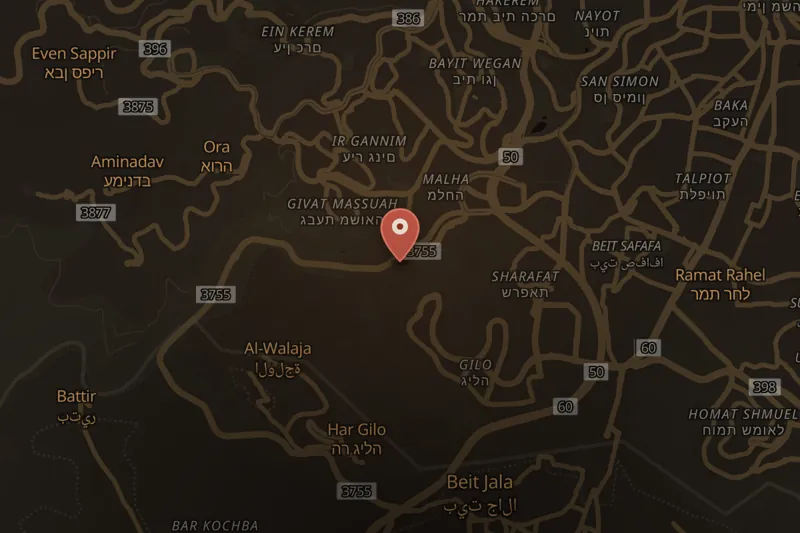
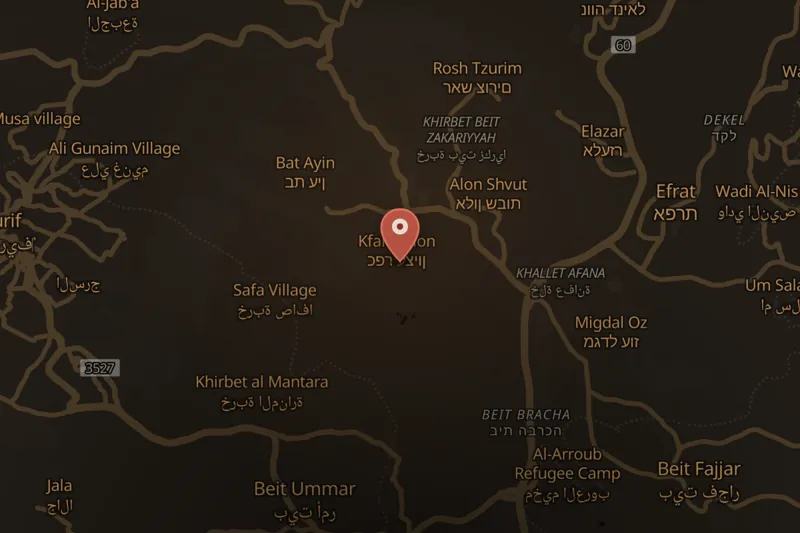
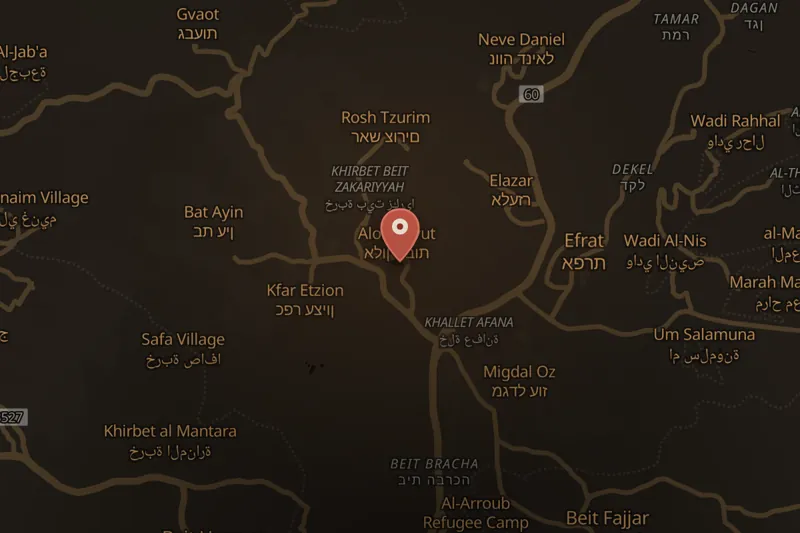
Kfar Etzion was a kibbutz founded in 1943 roughly 2 km west of the Jerusalem–Hebron road, and together with three nearby kibbutzim (Massu'ot Yitzhak, Ein Tzurim, and Revadim) formed the Gush Etzion (Etzion Bloc). By late 1947 the settlement had 163 adults and 50 children, many of them Holocaust survivors. The 1947 UN partition plan placed the bloc inside the proposed Arab state, and tensions with surrounding Arab communities escalated through late 1947 and early 1948, including an ambush of a relief convoy on December 10, 1947, and repeated clashes involving Haganah militia and Arab Legion units in the following months.
The final assault on Kfar Etzion began on May 12, 1948, when parts of two Arab Legion companies, reinforced by hundreds of local irregulars with armored cars and artillery, attacked the settlement. A request by the kibbutz commander to evacuate was denied by Haganah Central Command. On May 13, attackers broke through the settlement's defenses. According to the widely cited Israeli account, dozens of defenders laid down their arms and assembled in a courtyard, where they were suddenly fired upon; some who survived the initial volleys attempted to flee but were pursued and killed. Other accounts describe grenades thrown into a cellar where defenders or women were hiding, followed by the demolition of the building. Accounts differ on the exact circumstances of the surrender and on the relative roles of Arab Legion soldiers versus local irregulars, with an Arab Legion officer's account cited by historian Benny Morris disputing that a formal surrender had occurred and describing legionnaires shooting villagers who were carrying out killings.
Of the 127 Haganah fighters and kibbutz residents killed in the defense of the settlement, historian Martin Gilbert states that fifteen were killed after surrendering. Total death figures vary by source, ranging from about 127 to 157 or, per one estimate, 220. Only four prisoners—three Kfar Etzion residents and one Palmach member—survived the massacre and were later transferred to Transjordan; surviving testimony describes both protection offered by individual Arab Legion officers and participation by Legion soldiers in killings. The kibbutz was looted and razed following the surrender. The three other Etzion Bloc kibbutzim surrendered the next day and their residents were taken as prisoners of war to Jordan; some 320 prisoners were released in March 1949.
The victims' remains were left at the site for about a year and a half until the Jordanian government allowed Chief Military Rabbi Shlomo Goren to collect them in November 1949; they were buried with full military honors at Mount Herzl in Jerusalem on November 17, 1949, becoming the first grave in what is now the Mount Herzl military cemetery. On October 28, 1948, Israeli forces conquered the Arab village of al-Dawayima and killed an estimated 80 to 200 villagers, an act reportedly connected to blame placed on villagers for the Kfar Etzion massacre. Kfar Etzion was re-established as a kibbutz in September 1967 after Israel's capture of the West Bank, becoming the first Israeli settlement established there after the 1967 war.


 SOLVEDListen