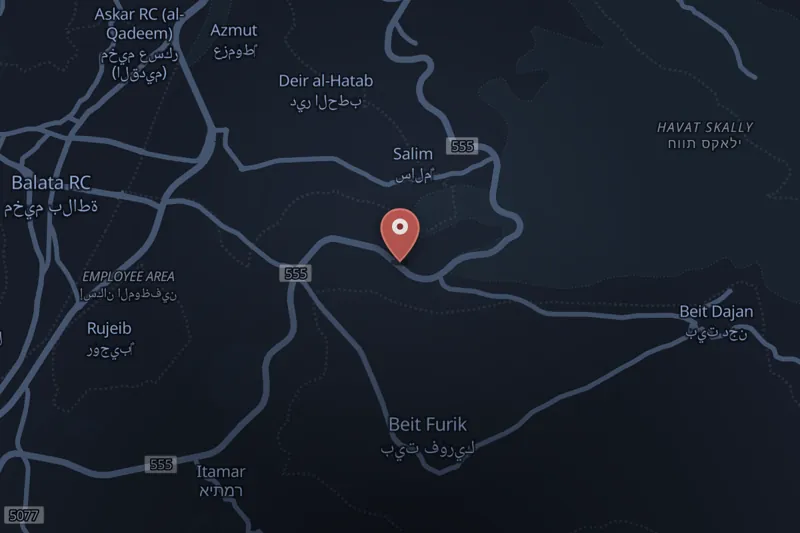
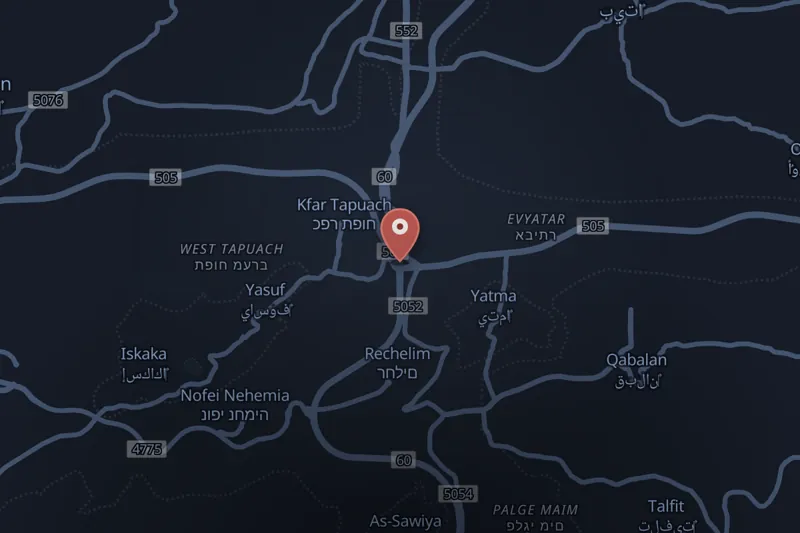
On the evening of October 12, 2018, Aisha al-Rabi, 47, was traveling with her husband Yaqoub, 51, and their 8-year-old daughter Rama on Highway 60 near the Tapuah Junction in the northern Israeli-occupied West Bank, south of Nablus. The family was returning to their home in Bidya, Salfit Governorate, from Hebron. As their car slowed roughly 100 meters before a permanent Israeli checkpoint at the junction, a group of settlers on the roadside began throwing stones at the vehicle. A rock weighing approximately two kilograms struck Aisha on the right side of her face near the ear, crushing her skull and causing her to lose consciousness. Her husband drove her to Rafidia hospital in Nablus, about 20 minutes away, where she was pronounced dead.
The Israeli internal security agency, Shin Bet, began investigating days later, a step that The Times of Israel reported signaled suspicion the attack had been carried out by settlers. The inquiry focused on Pri Ha'aretz, a religious boarding school in Rechelim near the attack site. Investigators noted that far-right activists from the nearby Yitzhar settlement had traveled to the school the morning after the killing, a day when observant Jews would typically not drive, which was viewed as an effort to help students prepare for questioning. In late December 2018, Shin Bet arrested three students, followed by two more days later; all were held and interrogated without immediate access to attorneys, drawing criticism from settler and pro-settler groups who alleged mistreatment, which Shin Bet denied. Four of the five detained minors were released to house arrest in January 2019, while the fifth, a 16-year-old, remained in custody. On January 24, 2019, he was indicted on charges including manslaughter, stone-throwing at a vehicle, and intentional sabotage of a vehicle, all under terrorism-related circumstances; the indictment cited DNA found on the rock that struck al-Rabi as key evidence.
In May 2019, a forensic review produced divided conclusions: of seven pathologists at Israel's National Center of Forensic Medicine who examined the case, two agreed that the injuries were inconsistent with a single rock strike, two found the evidence inconclusive, and two concluded a single rock could account for the wounds. The minor was subsequently released to house arrest and, by May 2020, was reported to have returned home to his settlement; his trial had not yet begun as of that report.
International officials, including the US Consulate General in Jerusalem, US Special Envoy Jason Greenblatt, and UN Special Coordinator Nickolay Mladenov, condemned the killing and called for accountability. Israeli officials were divided in their public responses. Because al-Rabi was not an Israeli citizen, her family was found ineligible for compensation through the Israeli National Insurance Institute; in August 2020 the Israeli government offered NIS 670,000, which the family, having sought over NIS 7,000,000, rejected.

 Credit: IDF Spokesperson's Unit photographerCC BY-SA 3.0SourceSOLVEDListen