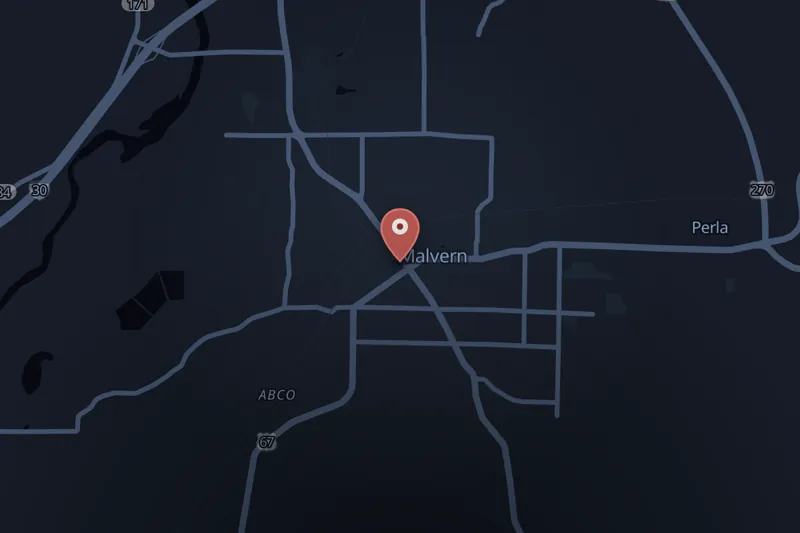
John Henry Harrison, also referred to in records as Harry Harrison or John Harris, was a 38-year-old African-American man living in Malvern, Hot Spring County, Arkansas. According to the 1920 census, he was married and worked as a laborer at a local lumber mill. Draft registration records from 1917 show he lived at 405 Vine Street in Malvern. In early 1922, reports emerged that Harrison had been stalking and threatening women. One woman reported this to Hot Spring County Sheriff Donald F. Bray, who arrested Harrison in February 1922.
Word of the arrest, along with claims that Harrison had been harassing white women, spread quickly through Malvern, and a mob gathered on the evening of February 2, 1922. Fearing a lynching, Sheriff Bray attempted to move Harrison out of town by road toward Arkadelphia, Arkansas, but found the roads blocked. He then tried to smuggle Harrison out by train, hiding him under a seat in the segregated "colored" section around 10:30 p.m. Before the train departed, roughly 20 men stopped it and searched car by car. Harrison was found, dragged a short distance away, and shot at least seventeen times, killing him.
The United States Senate Committee on the Judiciary later recorded this killing as the 10th of 61 documented lynchings in the United States in 1922, and one of five that year in Arkansas.
In 1923, Harrison's sister, Callie Henry, attempted to sue Sheriff D. S. Bray, deputies W. T. Gamble and S. H. Leiper, and W. H. Cooper over her brother's death while in their custody, as well as alleged mob leaders identified as Clarence Chamberlain, R. S. Hodges, Leonard Stanley, and Ray Galina. Courts ruled against her the following year, and no one was held criminally responsible for Harrison's killing.
Harrison's death is included among documented lynchings memorialized at the National Memorial for Peace and Justice in Montgomery, Alabama, which opened April 26, 2018, and displays hanging steel markers representing U.S. counties where lynchings occurred.

 COLDListen