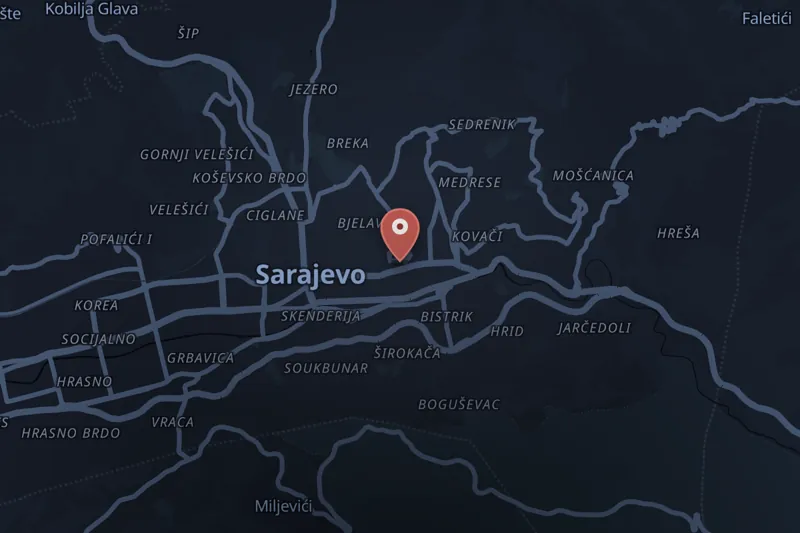
During the siege of Sarajevo in the Bosnian War, the Markale marketplace was struck by mortar fire in two separate incidents that killed civilians and drew international attention to the conflict.
The first attack occurred on 5 February 1994, between roughly 12:10 and 12:15, when a 120-millimetre mortar shell landed in the crowded marketplace, killing 68 people and wounding 144 more. Republika Srpska authorities denied responsibility and accused the Bosnian government of shelling its own civilians to provoke NATO intervention. An initial UNPROFOR report suggested the shell had come from Bosnian government positions, and General Michael Rose, the British head of UNPROFOR, later wrote in his memoirs that he had told a deputy commander of Bosnian government (ARBiH) forces this within days of the blast. A subsequent, more detailed UNPROFOR review found a calculation error in the original assessment and concluded it was impossible to determine which side had fired the shell. Some UN personnel, including observer Jan Segers and crater analyst John Russell, later expressed doubt that Serb forces were responsible. However, in December 2003 the ICTY Trial Chamber in the case against Bosnian Serb general Stanislav Galić concluded the massacre was committed by Serb forces, a finding the ICTY Appeals Chamber summarized in 2006 as reasonable, and Galić was found guilty of this and other shelling and sniping attacks and sentenced to life imprisonment. Ammunition expert Berko Zečević's investigation, introduced at trial, identified six possible firing locations, five under Army of Republika Srpska (VRS) control and one under ARBiH control; UNPROFOR observers had reported no shell was fired from the ARBiH-controlled site.
The second attack took place around 11:00 on 28 August 1995, when five mortar shells struck near the market, killing 43 people and wounding 75. It occurred hours after Bosnian Serb authorities had tentatively signaled willingness to accept a peace plan proposed by Richard Holbrooke. A 1999 UNPROFOR report to the UN General Assembly concluded, "beyond reasonable doubt," that all five rounds were fired from Bosnian Serb-held territory, likely the Lukavica area. David Harland, former head of UN Civil Affairs in Bosnia, testified that a "neutral" public statement by UNPROFOR commander General Rupert Smith obscured this finding at the time to protect UN personnel from potential Serb retaliation ahead of anticipated NATO action. This attack was cited as the trigger for NATO's Operation Deliberate Force against Bosnian Serb forces, contributing to the Dayton Peace Accords that ended the war.
Subsequent ICTY proceedings addressed responsibility for the 1995 attack. In 2007, Dragomir Milošević, former commander of the Sarajevo-Romanija Corps, was convicted of shelling and sniper attacks on Sarajevo, including the Markale attack, and sentenced to 33 years; the ICTY Appeals Chamber overturned the Markale-specific conviction in 2009, finding Milošević had been hospitalized at the time and that his deputy, Čedomir Sladoje, bore responsibility. Momčilo Perišić was acquitted by the ICTY Appeals Chamber in 2013. Radovan Karadžić attempted to use disputed evidence about the first attack in his defense but was found guilty at his ICTY trial.

 SOLVEDListen