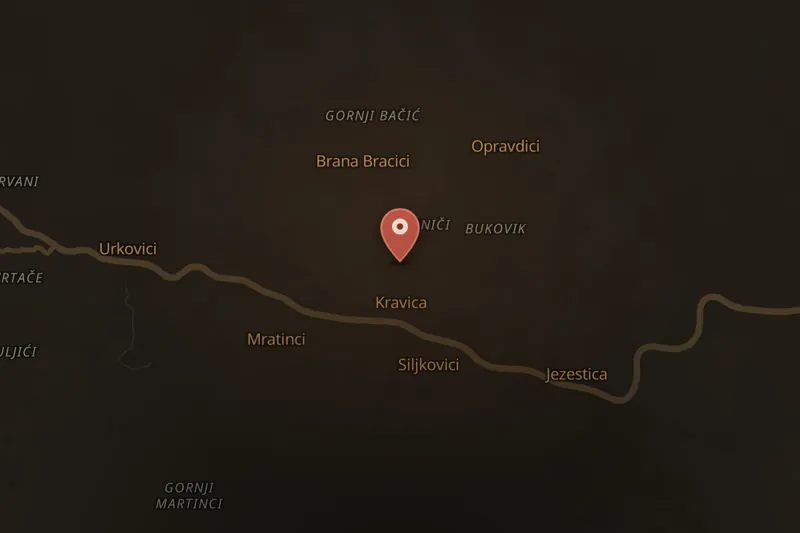
On 7 and 8 January 1993, Bosnian government (ARBiH) troops from a number of villages within the besieged Srebrenica enclave attacked the Serb-inhabited village of Kravica. The timing, on Orthodox Christmas Day, was reportedly organized to catch Serb defenders unprepared. Estimates place total deaths on the Serb side at between 41 and 48 people, comprising roughly 30-35 soldiers and 11-13 civilians. One document from the Army of Republika Srpska (VRS), titled "Warpath of the Bratunac Brigade," recorded 35 military and 11 civilian deaths; other sources cite 43 killed, including at least 13 civilians.
The attack occurred against a backdrop of prolonged conflict in eastern Bosnia. In April 1992, Serb and Bosnian Serb forces seized Bratunac and Srebrenica, followed by large-scale massacres. Bosniak forces under Naser Orić, then the local police commander, subsequently retook Srebrenica and established it as a besieged government-controlled enclave. According to the ICTY trial judgment in the case against Orić, Srebrenica and surrounding villages were subjected to constant Serb military assaults between April 1992 and March 1993, including shelling, sniper fire, and occasional aerial bombing, which produced large numbers of refugees and casualties. The judgment further found that fighting intensified in December 1992 and early January 1993, with Bosnian Muslims attacked primarily from the direction of Kravica and Ježestica, and that Bosniak counter-attacks on Serb-held villages, including Kravica, were partly aimed at securing food, weapons, and other supplies amid a Serb blockade that caused starvation in the enclave during the winter of 1992-1993.
During the Kravica attack itself, Serb village guards and some civilians present resisted with artillery and gunfire from houses and other buildings. Houses in the area were destroyed on a large scale, but the ICTY Trial Chamber found the evidence unclear as to how many were destroyed by Bosniak forces as opposed to other causes, and concluded this uncertainty meant the destruction did not meet the legal threshold for wanton destruction not justified by military necessity.
Naser Orić was tried by the ICTY in the Netherlands, with charges including wanton destruction and damage to civilian infrastructure at Kravica beyond military necessity. He was acquitted of these charges by the Trial Chamber in 2006 and acquitted of all charges on appeal in 2008.
The event has remained a subject of political controversy. According to Human Rights Watch, the Serbian Radical Party, around the 2005 tenth anniversary of the 1995 Srebrenica massacre, campaigned to publicize alleged Bosniak crimes against Serbs in the area, which Human Rights Watch said was intended to diminish the significance of the 1995 killings. Some Serb political figures, including former Republika Srpska president Milorad Dodik, have cited the Kravica attack as justification for the 1995 Srebrenica massacre. A member of Orić's unit wrote a song about the events referencing the Serb victims.

 Credit: FloUKkingdomCC BY-SA 3.0SourceSOLVEDListen