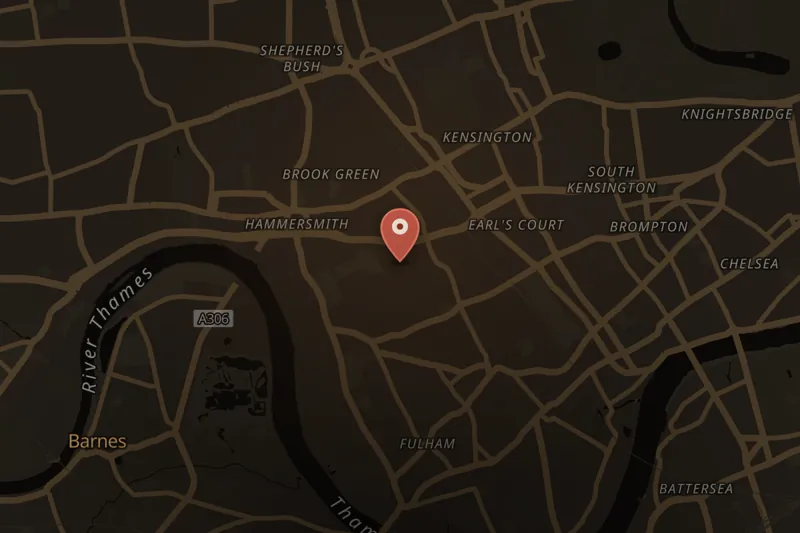
On 26 February 1975, four unarmed plain-clothed Metropolitan Police officers — Trainee Detective Constables Derek Wilson and Kenneth Mathews and Police Constables Adrian Blackledge and Les White — were conducting a surveillance operation for burglary suspects in the Fairholme Road area of West Kensington, London. PC Blackledge noticed a man behaving suspiciously outside a house on Fairholme Road and, after spotting him again roughly thirty minutes later, approached and identified himself as a police officer, asking the man to empty his pockets. The man was Liam Quinn, a US citizen from an Irish-American family in San Francisco who had adopted an Irish identity, including an affected accent, and who was a Provisional IRA volunteer serving in the organisation's active service unit operating in London at the time, having replaced Brendan Dowd.
Noticing Quinn was carrying a large amount of Irish currency, Blackledge said he wanted to escort him back to the Fairholme Road address he had been seen leaving. Quinn fled on foot, running west down Charleville Road, with Blackledge, Wilson and Mathews joining the pursuit. Off-duty PC Stephen Tibble, 21, married and a serving officer for six months, was riding past on his motorbike and was flagged down by Wilson. Tibble gave chase, riding past the officers on foot and past Quinn, before stopping at the junction of Charleville Road and Gledstanes Road. He dismounted, crouched, and spread his arms to block Quinn's path. Quinn then drew a .38 Long Colt revolver and shot Tibble twice in the chest at point-blank range. Tibble died three hours later in hospital. Quinn evaded capture, running through the ground floor of a tower block off Talgarth Road rather than into Barons Court tube station, as is often mistakenly reported.
Police subsequently discovered that the Fairholme Road flat Quinn had been seen entering was a bomb factory, containing enough equipment to construct roughly half a dozen high-explosive bombs, along with an automatic pistol, ammunition, English and Irish money, wigs, and a letter addressed to fellow IRA volunteer Joe O'Connell. This discovery led investigators to identify associates who later became known as the Balcombe Street gang, responsible for a series of bombings and killings in England, including the death of cancer specialist Gordon Hamilton-Fairley and the killing of Ross McWhirter.
Quinn fled to Dublin, where he was later arrested for assaulting a police officer and identified by one of the plain-clothed officers involved in the original chase; the Irish courts refused UK extradition requests. After serving a prison term in Ireland for IRA membership, Quinn returned to San Francisco. He was arrested there by the FBI in 1981 following a US-approved British extradition request and fought extradition for seven years before being sent to England in 1988, where he was tried and convicted of Tibble's murder. He was sentenced to life imprisonment with a recommended minimum of thirty years. Quinn served eleven years in Portlaoise prison before his release in April 1999 under the terms of the Good Friday Agreement.
Tibble was posthumously awarded the Queen's Police Medal for gallantry, the last such award given to a British police officer for gallantry rather than distinguished service, and a memorial was erected at the site of his death on Charleville Road in Barons Court.

 Credit: https://wellcomeimages.org/indexplus/obf_images/02/72/d61ea26e749b5ec38f6104f035b5.jpg…CC BY 4.0SourceSOLVEDListen


