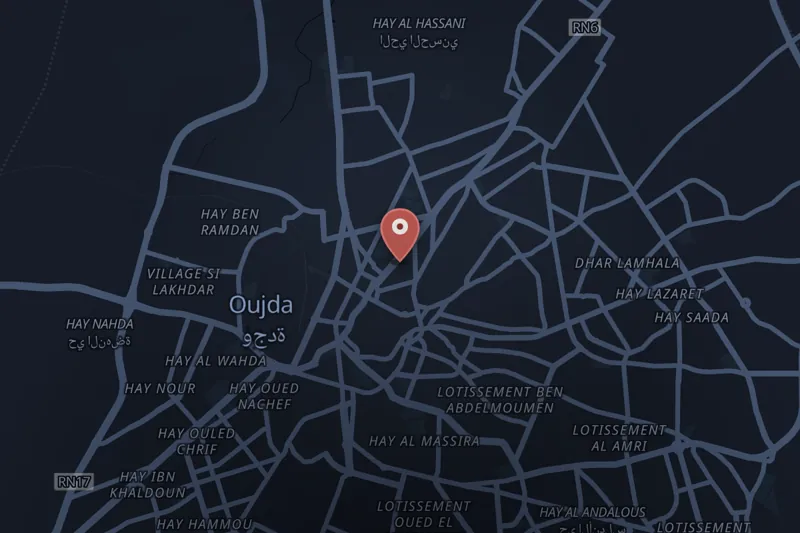
On June 7–8, 1948, anti-Jewish riots broke out in the towns of Oujda and Jerada in the French protectorate of Morocco. The violence occurred in the context of the 1948 Arab–Israeli War, which followed the May 14, 1948 declaration of the State of Israel. Oujda and Jerada, located near the Algerian border, served as departure points for Moroccan Jews seeking to migrate to Israel, though such emigration was not officially permitted from within Morocco at the time. In the riots, 47 Jews and one Frenchman were killed, many others were injured, and property was damaged.
The riots occurred weeks after a speech by Sultan Mohammed V that, in the context of the Nakba and the new State of Israel, affirmed the traditional protected status of Jews in Morocco while warning them against demonstrating solidarity with the Zionist cause. Many Moroccan Muslims viewed Jews emigrating to Israel as effectively joining the forces fighting Arab armies. French officials characterized the riots as "absolutely localized" to the two towns, attributing the unrest to anger over migration itself rather than to broader anti-Jewish sentiment.
According to René Brunel, the French Commissioner for the Oujda region, the rioting began when a Jewish barber attempted to cross into Algeria carrying explosives. Brunel described the local atmosphere as having "overheated" due to the clandestine passage of young Zionists from across Morocco attempting to reach Palestine via Algeria. The French Ministry of Foreign Affairs similarly noted that Jewish emigration from Oujda was a significant irritant to the local Muslim population, observing that residents near the Algerian border viewed departing Jews as combatants for Israel. Alphonse Juin, the Resident General in Morocco, attributed the violence to the "clandestine departure of Jews for Palestine" combined with agitation by "professional agitators." Some accounts have also suggested a connection to Sultan Mohammed V's speech, though others argue his remarks were primarily focused on protecting Moroccan Jews.
The rioting began in Oujda, the main transit hub for Jewish emigration due to its proximity to Algeria, where five Jews were killed and 30 injured within three hours before the army arrived. The violence in the nearby mining town of Jerada was more severe, resulting in 39 deaths.
In the aftermath, French Commissioner Brunel blamed the violence on Jews for leaving through Oujda and for sympathizing with Zionism, while the French League for Human Rights and Citizenship blamed French colonial authorities for relaxed security in the area. A French military court tried 35 people for involvement in the violence; two were sentenced to death, two received life imprisonment, and the remaining 31 received lesser prison terms.
The events accelerated Jewish emigration from Morocco: 18,000 Moroccan Jews left for Israel the following year, and roughly 110,000 of Morocco's 250,000 Jews departed between 1948 and 1956. The riots were reported at the time in the Sydney Jewish News, which described them as a pogrom.


 Credit: National Human Rights Council of the Kingdom of MoroccoPublic domainSourceUNSOLVEDListen