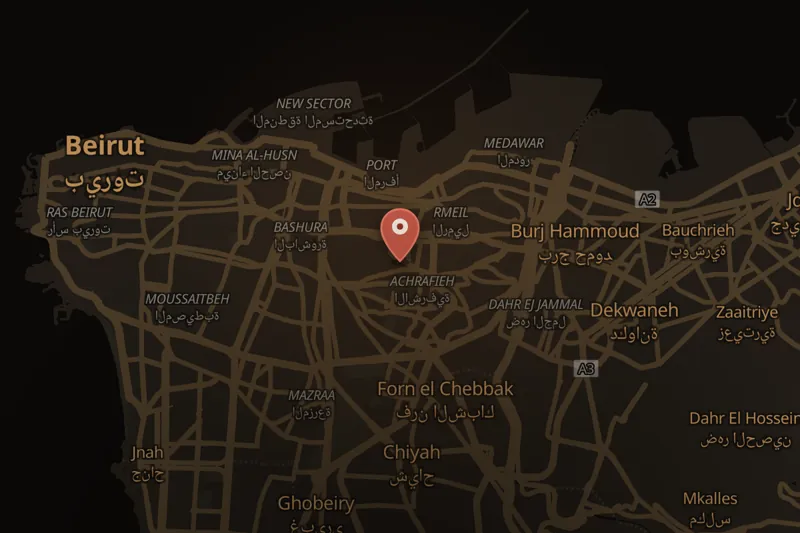
On 19 October 2012, a car bomb detonated at 14:50 on Ibrahim Monzer Street near Sassine Square in the Achrafieh district of Beirut, a largely Greek Orthodox Christian neighborhood. The blast killed Wissam al-Hassan, a brigadier general and head of the intelligence-oriented information branch of Lebanon's Internal Security Forces (ISF), along with several others, including his driver Ahmad Suhyuni. Lebanon's National News Agency initially reported eight deaths and more than 90 injured, figures later revised to four deaths and 110 injured, making it the deadliest bombing in Beirut since 2008.
Al-Hassan was a key figure in the opposition March 14 alliance and one of Lebanon's leading Sunni Muslim political figures. He had previously led the investigation that implicated Syria and its ally Hezbollah in the 2005 assassination of former prime minister Rafik Hariri. In the summer of 2012, he led an investigation that uncovered what the Lebanese government alleged were Syrian government plots to interfere in Lebanon's internal conflict, including the arrest of former information minister Michel Samaha, who was charged with transporting explosives into Lebanon allegedly with the help of Syrian Security Chief Ali Mamlouk. The attack occurred near al-Hassan's secret office used for meetings with informants, and he was traveling in an unarmored rental car used for camouflage. Lebanese Army explosive experts estimated the device was equivalent to 30 kilograms of TNT, describing the explosion as "massive" and noting it left a large crevice in the road and tore balconies off nearby buildings.
The killing prompted immediate speculation that Syria or its allies were responsible, given al-Hassan's close ties to the anti-Assad camp. A report in Der Spiegel suggested Hezbollah might have been involved, citing al-Hassan's cooperation with the International Criminal Tribunal. The FBI reportedly noted similarities between this attack and the Hariri assassination in terms of explosives, planning, and execution, suggesting a common group of perpetrators.
Lebanese Prime Minister Najib Mikati said his government would work to identify and punish the perpetrators, while linking the assassination to the Samaha arrest. Saad Hariri publicly stated he had no doubt Syrian President Bashar al-Assad was responsible, an accusation echoed by other March 14 alliance politicians, some of whom called for Mikati's resignation. Hezbollah condemned the bombing as a "sinful attempt to target the stability and national unity."
Al-Hassan was buried on 21 October near Rafik Hariri's tomb at Martyrs' Square in Beirut. Following the funeral, demonstrations calling for the government's resignation led to riots near the Grand Serail and sectarian clashes that killed six people, along with fighting between Lebanese troops and armed men. The bombing drew international condemnation, including from the United Nations Security Council, the European Union, France, Syria, Iran, Saudi Arabia, and the United States.


 Credit: James BradburyCC BY-SA 4.0SourceSOLVEDListen