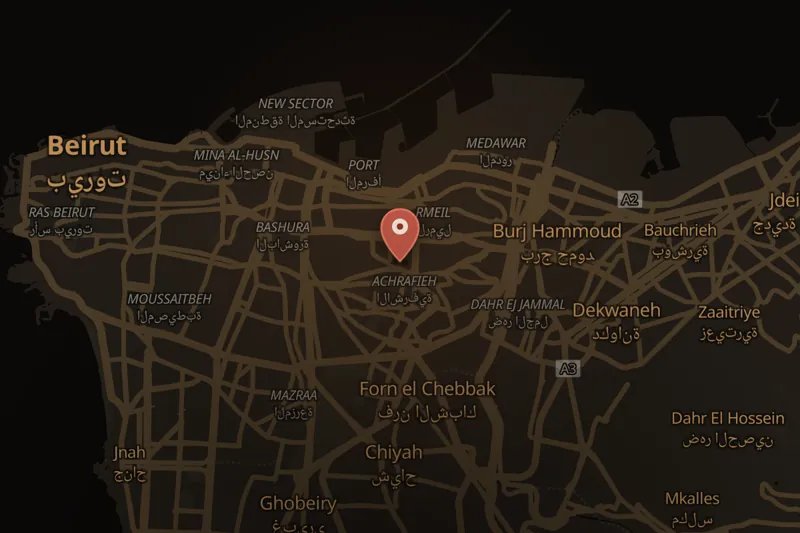
On 14 September 1982, an explosive device containing an estimated 180 kilograms of TNT was detonated during a meeting of the right-wing Kataeb Party (Phalanges) at their headquarters in the Achrafieh neighborhood of Beirut. Militia commander and Lebanese president-elect Bashir Gemayel and 23 other Kataeb Party politicians were killed in the blast. Gemayel had been elected president on 23 August 1982 in a vote boycotted by Muslim members of parliament, prevailing as the only declared candidate over the National Movement.
The attack was carried out by Habib Shartouni and allegedly planned by Nabil Alam, both members of the Syrian Social Nationalist Party (SSNP). Both men were believed to have acted on instructions from the Syrian government led by President Hafez al-Assad. Shartouni, a Maronite Christian from the village of Chartoun in Aley, had joined the SSNP in the late 1970s and met Alam, the party's chief of interior, through secret party meetings in Paris.
In the hours after the explosion, conflicting reports circulated about Gemayel's fate, including claims he was being treated for leg injuries at a nearby hospital or had been evacuated by helicopter to Haifa. His body was reportedly identified roughly five and a half hours after the blast by a Mossad agent at a nearby church, though his wife, Solange, stated the identification occurred about six hours later at Hôtel-Dieu de France hospital, based on a letter and his wedding ring. Then-Prime Minister Shafik Wazzan confirmed Gemayel's death the following morning.
Following the assassination, Israeli Prime Minister Menachem Begin, Defense Minister Ariel Sharon, and Chief of Staff Rafael Eitan agreed the Israeli army should move into West Beirut, and on 15 September Israeli forces entered the city in violation of a 1981 ceasefire. Sharon and Eitan reportedly agreed the IDF itself would not enter Palestinian refugee camps but that Phalange forces would be used instead. Lebanese Forces militia members under Elie Hobeika subsequently killed between 1,300 and 3,500 civilians, mostly Palestinians and Lebanese Shia Muslims, in the Sabra and Shatila refugee camps, in what was described as retaliation for the assassination and was overseen by the IDF. The United Nations Security Council passed Resolution 520 demanding Israel's immediate withdrawal from Lebanon. Bachir's older brother, Amine Gemayel, was elected president shortly afterward, serving from 1982 to 1988.
Legally, Habib Shartouni was held for eight years in Roumieh prison without an official trial before escaping during the final Syrian offensive that ended the Lebanese Civil War. He later admitted his role in interviews in the 1990s and 2010s. On 20 October (year unspecified in the source), Lebanon's Judicial Council sentenced Shartouni and Nabil Alam to death in absentia and stripped them of their civil rights, following a third trial in 2017 that drew protests from both SSNP and Kataeb supporters.


 Credit: SassinemichelCC BY-SA 3.0SourceUNSOLVEDListen


