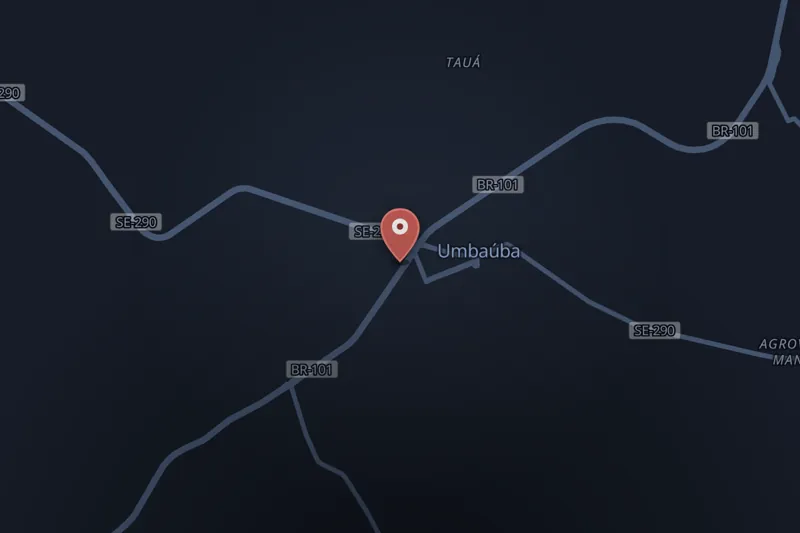
On 25 May 2022, at around midnight local time, Federal Highway Police (PRF) agents stopped Genivaldo de Jesus Santos on his motorbike on the BR-101 highway in Umbaúba, in the southern part of the Brazilian state of Sergipe, reportedly because he was not wearing a helmet. Santos, 38, was retired due to a schizophrenia diagnosis and had been on controlled psychiatric medication for twenty years. He was married with a seven-year-old son and an 18-year-old stepson.
According to witnesses, including his nephew Wallison de Jesus, Santos initially complied with police commands. During the stop, an officer asked him to lift his shirt; Santos said he was carrying psychiatric medication and had a prescription. Witness videos show officers searching him and swearing at him, after which he became upset and was knocked down and immobilized, with one officer's leg placed on his neck. Despite the nephew informing police that his uncle was schizophrenic, reinforcements were called. Witnesses said Santos was then subjected to pepper spray, kicks, and stomps over a period of roughly thirty minutes.
Santos was placed in the back of a police vehicle with the boot lid held against him, and officers threw a gas canister inside the vehicle, producing visible white smoke. After he stopped moving and screaming, officers closed the vehicle and left the scene. He was taken to a police station, found unconscious, and then transported to José Nailson Moura Hospital, where he was pronounced dead. Brazil's Forensic Medical Institute (IML) attributed his death to mechanical asphyxia and acute respiratory failure.
In an official statement, the PRF said Santos had "actively resisted" and that "immobilization techniques and instruments of less offensive potential" had been used. The statement did not address the use of the gas canister inside the locked vehicle. The PRF opened a disciplinary procedure and removed the officers involved; the Federal Police, the Public Prosecutor's Office (MPF), and the Federal Senate's Human Rights Commission also opened inquiries. Brazil's Minister of Justice at the time, Anderson Torres, ordered federal investigations into the incident.
The case drew international attention, occurring exactly two years after the murder of George Floyd in the United States, with commentators drawing comparisons between the two deaths. Human Rights Watch and the United Nations Human Rights Office for South America both called for thorough investigations. Protests took place in Umbaúba, Brasília, and São Paulo, and the case was covered by numerous international outlets, including Reuters and BBC News.
On 7 December 2024, three of the officers involved — Paulo Rodolpho Lima Nascimento, William de Barros Noia, and Kleber Nascimento Freitas — were convicted and sentenced to prison terms ranging from 23 to 28 years for Santos's killing.