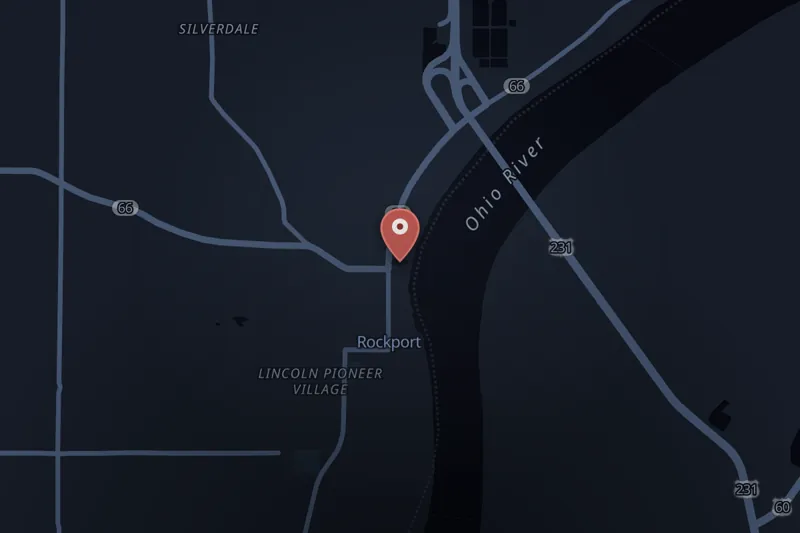
On December 16, 1900, Bud Rowland and Jim Henderson, two Black men, were arrested in Rockport, Indiana, following the killing of Hollie L. Simmons, a white barber who was reportedly attacked by two men and struck with a nail-covered club. As word of the killing spread through town that night, suspects were identified and Rowland and Henderson were taken into custody and placed in the local jail.
Shortly after they were jailed, a large group of white residents used sledgehammers and a broken telegraph pole to break into the jail. While preparing to hang Rowland, the mob heard him say he had an accomplice known as "Crowfoot." The mob then pulled Rowland from his cell, hanged him from a tree beside the courthouse, and shot his body with bullets. The group returned for Henderson, shot him inside his cell, dragged his body across the courtyard, and hanged him next to Rowland.
Following the killings of Rowland and Henderson, the mob searched for the man known as "Crowfoot" and located him at a local hotel, where he had identified himself as Joe Holly. This man was John Rolla, who was also known by the names "Joe Crowfoot," "Hustling Joe," and "Whistling Joe." Spencer County sheriffs transferred Rolla to a jail in the neighboring town of Boonville. On the night of December 17, 1900, a crowd that had traveled from Rockport broke into the Boonville jail. Despite Rolla's pleas for mercy, the crowd hanged him in front of the Boonville Courthouse.
Little biographical information about the three men has been documented. Rolla was reported to be from Edmondson, Arkansas, and his final wish — that his body be returned to his family — was not carried out. No record exists of last wishes expressed by Rowland or Henderson.
This lynching is one of at least eighteen documented lynchings of Black people in Indiana between 1877 and 1950. The killings of Rowland, Henderson, and Rolla have since been memorialized by the Equal Justice Initiative (EJI) in its report "Lynching in America: Confronting the Legacy of Racial Terror," which documents lynchings across the American South and in states outside the South where anti-Black violence occurred. The three men are also memorialized at the National Memorial for Peace and Justice.


 SOLVEDListen